
Blog Details
- Member
- November 17, 2026
From the Democratisation of Writing to the Democratisation of Creation
Human creativity is entering a new phase: from privileged authorship to mass participation. Over two centuries, expanding literacy, affordable publishing and digital connectivity have lowered the barriers to expression. Artificial intelligence is accelerating this shift by helping people transform ideas into writing, video, music, design, educational resources and interactive experiences. Srijan Sanchar views this not merely as the growth of content, but as a democratisation of creation. Using IEF v3.0, we seek to map its drivers, regional patterns and trajectories. The opportunity is to move people from consuming and expressing knowledge to synthesising ideas, innovating and creating value for humanity.
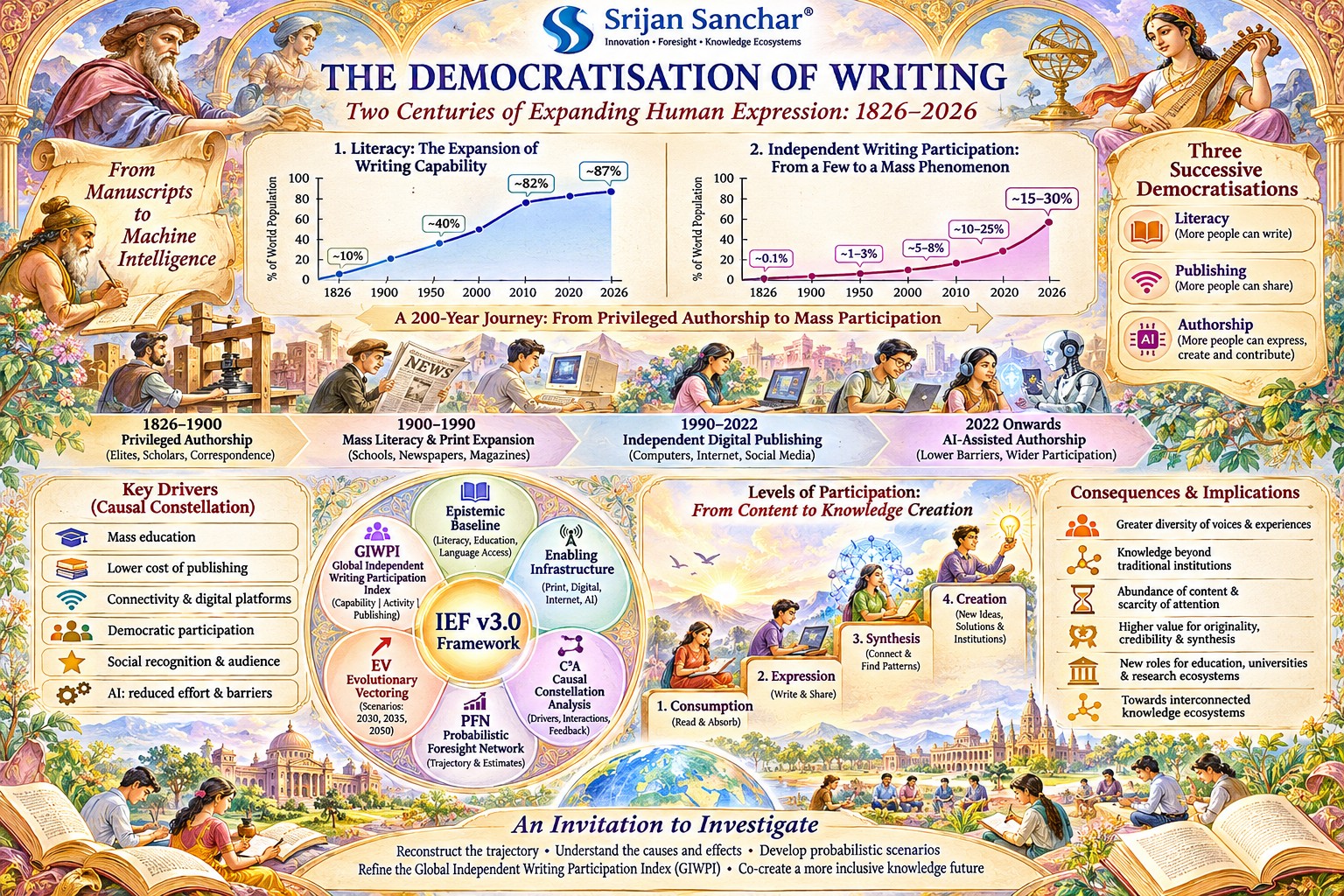
The Democratisation of Writing: 1826–2026
From the printing press to the internet and artificial intelligence
This is a fascinating phenomenon to investigate because it may represent one of the most significant changes in the history of human knowledge creation: the transition of writing from a relatively privileged activity to a mass-participation activity.
Your hypothesis is that the internet, and subsequently AI, have dramatically increased the proportion of humanity that independently produces written content.
I would investigate this through a 200-year historical series, looking at two variables:
Number of independent writers: People who independently produce written material, whether or not writing is their profession.
Independent writers as a percentage of world population: This is the more revealing measure because it accounts for population growth.
There is an important distinction: we should not count only professional authors, journalists and published writers. We should include people who write letters, essays, blogs, social media posts, newsletters, online articles and other original content.
We should also distinguish between someone who writes occasionally and someone who regularly publishes. AI introduces a further distinction between human-authored, AI-assisted and predominantly AI-generated content.
1. What the historical evidence tells us
We have some strong indicators, although no reliable global census of independent writers exists.
Year | Relevant evidence | What it indicates |
|---|---|---|
1820 | About 10% of adults literate | Writing was accessible to a small minority |
1930 | About 33% literate | Expansion of mass education |
2000 | About 398 million internet users | Beginning of digital publishing at scale |
2010 | About 2 billion internet users | Blogs, forums and social media expanding |
2020 | About 4.6 billion internet users | Mass digital participation |
2025 | About 6.04 billion internet users | A global publishing infrastructure |
Sources: Our World in Data and the ITU/Kepios historical internet-user series.
The literacy figures are particularly important. In 1820, fewer than 100 million people worldwide could read and write, compared with approximately 5.1 billion today.
However, literacy is not equivalent to writing independently. It represents the potential to write, not actual participation in writing.
2. The four historical transitions
I would divide the 200-year period into four phases.
1826–1900: The era of privileged authorship
Writing was concentrated among educated elites, administrators, scholars, religious institutions, journalists and literary communities. Printing expanded the audience, but not necessarily the number of independent writers.
1900–1990: The era of mass literacy
Universal schooling, typewriters, affordable printing, newspapers, magazines and publishing houses widened participation. Yet distribution remained controlled by editorial and publishing institutions.
1990–2022: The era of independent digital publishing
Websites, blogs, email, Facebook, LinkedIn, X, online magazines and self-publishing removed many traditional barriers to publication.
2022 onwards: The era of AI-assisted authorship
AI reduces the effort needed to formulate, structure, translate, edit and publish ideas. People who previously had ideas but lacked writing confidence or skills can now become content producers.
3. A preliminary quantitative graph
The following two graphs establish the historical foundation. They are indicators of the potential to write and the infrastructure for publishing, not direct measurements of independent writers.
A. Expansion of literacy
Share of adults able to read and write a simple statement. Historical estimates; definitions vary.
B. Expansion of digital publishing infrastructure
Approximate percentage of world population using the internet. Internet access is a potential enabler of publishing, not proof of writing.
Sources:
4. The AI inflection point
There is already evidence that AI is extending participation beyond conventional internet publishing.
For example, the OECD's 2026 report presents 2025 survey data showing that 37.2% of the OECD population used generative AI tools to create content in the preceding three months. This includes content beyond writing, and cannot be interpreted as the percentage of people who independently write. Nevertheless, it is a significant indicator of the changing nature of content production.
5. How I propose we actually measure independent writers
I suggest that we construct a new indicator:
Global Independent Writing Participation Index (GIWPI)
The unit of measurement should be an individual, not the number of articles, posts or publications.
We could define three levels:
Category | Operational definition |
|---|---|
Occasional writer | Independently produces at least one original written contribution in a year |
Regular writer | Produces original written content at least monthly |
Active publisher | Publishes original written content at least weekly on a public platform or through independent distribution |
We should separately classify:
Personal correspondence and private writing.
Public social media writing.
Blogs, newsletters and independent magazines.
Professional and academic writing.
AI-assisted writing.
Predominantly AI-generated publishing.
The distinction between original thought and the mechanical production of text is especially important.
6. The graph we should ultimately aim to produce
I would like to see three curves on the same historical timeline.
Conceptual structure, not measured historical data. The actual curves must be estimated and validated using surveys and historical evidence.
Important: The independent-writing and publishing curves above are hypothetical illustrations to show the proposed model. They are not empirical estimates and should not be quoted as statistics.
The final research should replace these illustrative values with defensible estimates and confidence intervals.
7. A potentially more interesting question
I think there is a larger phenomenon hidden inside this investigation.
For centuries, the ability to produce knowledge and the ability to distribute knowledge were concentrated in relatively few hands.
The internet democratised distribution.
AI is now democratising the production of written expression itself.
But there is a paradox: as the number of people writing increases, the relative scarcity of original thinking, meaningful insights, synthesis and genuinely new knowledge may increase.
This has important implications for Srijan Sanchar's work on knowledge ecosystems, storytelling and interdisciplinary knowledge creation.
My recommendation: Let us make this a proper quantitative research exercise rather than simply draw a speculative historical graph. The first priority should be to estimate the number of people who actually write independently, as distinct from the number who are merely literate or connected to the internet.
That would give us a potentially valuable research proposition: The Democratisation of Authorship, 1826–2026: Two Centuries of Expansion in Humanity's Capacity to Express, Publish and Create Knowledge.