
Blog Details
- Member
- September 23, 2026
The Bio Methane Carrier
SRIJAN SANCHAR
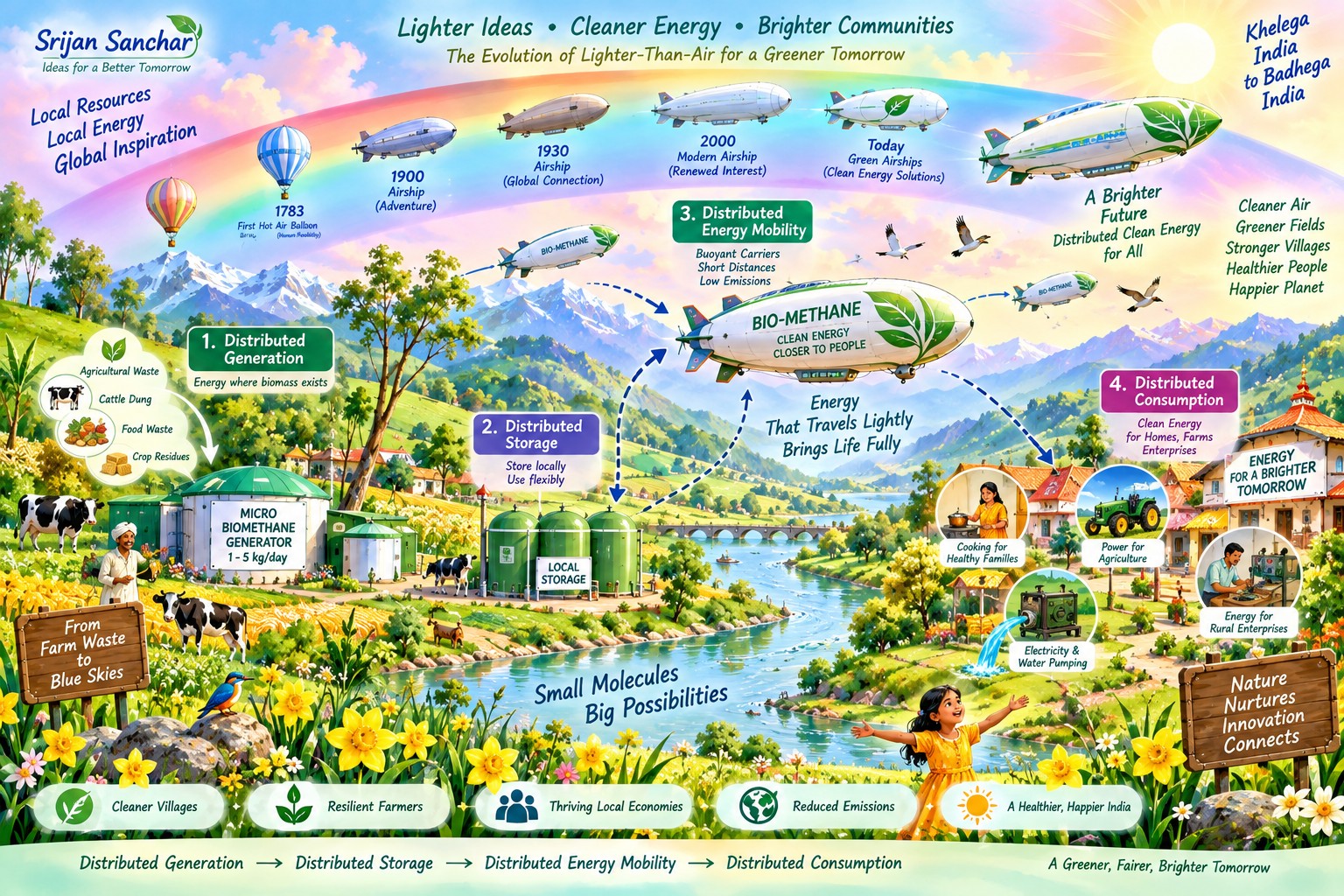
DISTRIBUTED BIO-METHANE ENERGY MOBILITY
A General Concept for Distributed Rural Energy Infrastructure
A self-contained concept for moving from centralized energy delivery
towards an architecture of Distributed Generation, Distributed Storage,
Distributed Energy Mobility and Distributed Consumption.
1. PROMISE
The promise is to serve rural and underserved communities where
energy demand is dispersed, individual requirements are small, biomass is
locally available and conventional fixed distribution infrastructure may be
difficult or uneconomic. The proposition is to make small quantities of locally
produced biomethane movable.
A village, farm, dairy, community or rural enterprise can become a
small energy-production node; a carrier can become the mobility layer between
nodes; and a local energy point can become the place where that energy is
converted into cooking, mechanical, thermal or electrical energy.
The deeper promise is not simply a new airship or a new method of
transporting gas. It is a new way of thinking about energy infrastructure:
infrastructure matched to the spatial scale of the resource and demand.
This creates the possibility of a complementary energy architecture
for places where a large centralized plant and permanent pipeline may not be
the most appropriate first infrastructure.
2. IMPERATIVES
The first imperative is to serve the unserved and underserved. Fixed
infrastructure is powerful where demand is dense and predictable, but becomes
harder to justify as consumers become more dispersed and individual energy
requirements become smaller.
The second imperative is feedstock proximity. Instead of
transporting bulky cattle dung, agricultural residues, food waste and other
organic material towards a large centralized facility, the system can
investigate conversion close to the resource and movement of the higher-value
energy product.
The third imperative is to connect production, storage and
consumption in both space and time. Energy may be produced at one place and
required at another, or produced continuously while consumption occurs in
larger batches.
The fourth imperative is complementarity. The proposed architecture
should not be presented as a universal substitute for centralized biomethane
plants, pipelines, electricity networks or conventional fuel logistics. It
should be examined specifically where proximity, sparsity, short distances and
local biomass may create an advantage.
The fifth imperative is to evaluate delivered useful energy rather
than production cost alone. The relevant question is what it costs, in energy
and money, to make useful energy reliably available to the consumer.
3. CONCEPT
Two fundamentally different architectures can be compared at equal
delivered energy. The conventional model is **Central Generation →
Transmission/Pipeline → Distributed Consumption**. The proposed distributed
model is **Distributed Generation → Distributed Storage → Distributed Energy
Mobility → Distributed Consumption**.
In the centralized model, a large biomethane plant gains economies
of scale in digestion, gas cleaning, upgrading, compression, instrumentation,
maintenance and quality control. Gas is then transported through fixed
infrastructure to consumption clusters.
In the distributed model, many small generation nodes are located
close to the biomass resource. Gas can be stored locally and moved in small
parcels by a purpose-designed carrier to nearby energy nodes. The network
therefore distributes not only consumption but also generation, storage and
mobility.
The fundamental conceptual shift is: **the centralized system moves
energy through infrastructure; the distributed system moves infrastructure to
the energy.**
At very small scale, a producer generating approximately 5 kg/day
and a consumer requiring approximately 5 kg/day illustrate the proposition:
energy can potentially be produced, moved and consumed without automatically
requiring a dedicated pipeline. The carrier becomes conceptually an energy
container that can move independently of fixed gas infrastructure.
The carrier should not initially be defined as a conventional
autonomous airship. The more appropriate research proposition is a
**buoyancy-assisted energy container**: a low-altitude, ground-supervised
carrier in which biomethane may contribute to buoyancy, potentially
supplemented by thermal buoyancy, tethering or other forms of ground
assistance.
4. STRUCTURE
The architecture has four mutually reinforcing layers.
**Distributed Generation.** Small biogas or biomethane production
units are located close to cattle, agricultural residues, food waste and other
suitable organic feedstocks. Generation can be matched to local resource
availability rather than to the economics of one large collection radius.
**Distributed Storage.** Energy produced locally is conditioned and
stored so that production and consumption do not have to occur simultaneously.
Storage may be stationary at the generation node, mobile within the carrier, or
distributed between both.
**Distributed Energy Mobility.** A specialized carrier provides
short-distance logistics between generation and consumption nodes. The carrier
becomes the mobility layer of decentralized energy. It can move small parcels,
consolidate several small production streams or accumulate energy for a later
transfer.
**Distributed Consumption.** Local households, farms, institutions
and rural enterprises use the energy for cooking, engines, electricity
generation, water pumping, thermal applications or agro-processing.
The consumption interface should be standardized: **carrier →
controlled docking → isolation/regulation → metering → energy converter**,
rather than direct connection between a gas carrier and an appliance.
5. ARCHITECTURAL COMPARISON
|
Dimension |
Centralized + Pipeline |
Distributed + Buoyant Carrier |
|
Generation |
One/few large plants |
Many micro-plants |
|
Primary distribution |
Pipeline |
Mobile carrier |
|
Feedstock logistics |
Potentially significant |
Potentially much lower |
|
Transport |
Continuous |
Small parcels/batches |
|
Scale economy |
High |
Lower |
|
Fixed infrastructure |
High |
Potentially modular |
|
Route flexibility |
Low after pipeline |
Potentially high |
|
Redundancy |
Central/network dependent |
Many independent sources |
|
Maintenance |
Centralized specialists |
Distributed maintenance challenge |
|
Weather sensitivity |
Low |
Potentially significant |
|
Technology maturity |
High |
Experimental |
|
Dense demand |
Strong structural fit |
Less obvious advantage |
|
Sparse short-distance demand |
Potentially difficult to justify |
Potentially interesting |
A fair comparison should use equal delivered energy. A useful
conceptual case is 100 consumption points requiring 5 kg/day each, or 500
kg/day total. The question is not which architecture is universally superior,
but at what spatial density and demand scale economies of proximity can
overcome economies of scale.
6. POSSIBILITIES
The first possibility is a rural energy network in which small
producers and small consumers are connected without requiring a continuous
pipeline between every pair. The carrier becomes a last-mile or middle-mile
energy connector.
The second possibility is feedstock proximity. Organic material can
potentially be converted near its source, reducing the need to move bulky
biomass towards a centralized facility and instead moving a more energy-dense
product.
The third possibility is temporal energy matching. A producer may
generate 5 kg/day while a consumer requires 15 kg every third day;
alternatively, several producers may combine their output for one delivery. The
carrier can therefore become a mobile energy buffer that matches when energy is
produced with where and when it is required.
The fourth possibility is a fleet model in which carrier inventory
becomes temporary distributed storage. Different carriers can be assigned to
different routes, held at energy nodes or dispatched according to demand.
The fifth possibility is modular expansion. A network can grow by
adding generation units, storage units, carriers and energy nodes rather than
building one large piece of infrastructure before demand exists.
The sixth possibility is a hybrid architecture. Large biomethane
plants and pipelines can serve dense urban and industrial demand, while
micro-plants and carrier networks can serve dispersed rural demand. The future
system can therefore combine **economies of scale** with **economies of
proximity**.
The seventh possibility is an energy-service model in which the
consumer does not need to own the generation equipment. Local operators could
produce, store, transport and supply energy as a service, subject to
appropriate regulation and economics.
7. CHALLENGES REQUIRING TO BE ADDRESSED
The first challenge is micro-scale economics. Centralized plants
spread the cost of digestion, upgrading, gas cleaning, compression,
instrumentation, maintenance and skilled operation over large output. A 1–5
kg/day system must overcome this loss of scale through simplicity, local
feedstock, modularity and lower distribution infrastructure.
The second challenge is recurring carrier logistics. A pipeline has
high fixed cost but relatively low marginal transport effort once constructed.
A carrier must load, travel, land, dock, transfer and return. Utilization,
distance, turnaround time and maintenance therefore matter.
The third challenge is physical feasibility. Approximately 5 kg of
methane occupies roughly 7–8 m³ near ambient conditions, while its theoretical
gross buoyancy relative to air is only around 4 kg before the mass of the
carrier is considered. System mass, envelope design, supplemental buoyancy and
ground support are therefore central engineering questions.
The fourth challenge is thermal buoyancy. Heating biomethane can
reduce its density and increase its volume, but heat input, heat loss,
containment, temperature control, pressure behaviour and safety must all be
demonstrated rather than assumed.
The fifth challenge is gas safety. Methane containment, leak
detection, ignition control, isolation, pressure regulation, controlled docking
and emergency procedures must be designed into the system from the beginning.
The sixth challenge is weather and terrain. Wind, convection, rain
and local topography may constrain low-altitude operations. Initial
demonstrations should therefore be tethered, ground-supervised and limited to a
defined operating envelope.
The seventh challenge is regulation and standardization. Gas
handling, pressure systems, waste processing, fire safety, transport and
low-altitude lighter-than-air operations may involve multiple regulatory
domains. A viable system will require a clear compliance pathway and
standardized interfaces.
The eighth challenge is technological maturity. Centralized
biomethane and pipeline systems have established operating practices, whereas
the proposed carrier architecture is experimental. Development must therefore
be evidence-led and should not assume commercial viability before technical
validation.
8. FORESIGHT
The long-term significance of the proposition may lie less in the
carrier itself than in the emergence of a new category of energy
infrastructure: **Distributed Energy Mobility**.
The first future state is a network of independent local energy
nodes. Each node can generate, store and consume energy locally, while carriers
provide flexible links between nodes.
The second future state is an energy-matching network. Digital
systems could coordinate production, storage, demand and carrier availability
so that energy moves where it has the greatest local requirement. The carrier
fleet becomes part of an intelligent distributed energy system.
The third future state is a hybrid national architecture in which
centralized plants and pipelines handle high-density demand while distributed
generation, storage and mobility serve low-volume, dispersed and
infrastructure-poor locations. The boundary between the two would be determined
by delivered cost, reliability and geography rather than by choosing one
architecture universally.
The fourth future state is a broader principle that may extend
beyond biomethane. Once energy can be considered a movable, modular parcel
rather than only a continuous flow through fixed infrastructure, other forms of
distributed energy storage and mobility can be explored through the same
framework.
The central foresight question is therefore not **centralized versus
decentralized**. It is: **What spatial scale of infrastructure is appropriate
to the spatial scale of the resource and demand?**
This leads to a possible Srijan Sanchar proposition: **Centralized
systems move energy through infrastructure; distributed systems move
infrastructure to the energy.**
9. FORESIGHT-TO-EVIDENCE FRAMEWORK
The concept should ultimately be evaluated through five measurable
outcomes rather than through the novelty of the carrier alone:
·
₹/kg of biomethane delivered to
the consumer, rather than merely produced.
·
₹/kWh of useful energy after
conversion efficiency and network losses.
·
Infrastructure cost per
consumer, comparing pipeline and distributed node/carrier systems.
·
Total energy loss or energy
expenditure across upgrading, storage, transport, transfer and conversion.
·
Reliability: whether the
consumer receives the required energy when needed.
The next analytical exercise should be a numerical equal-energy
comparison, such as 100 consumers × 5 kg/day = 500 kg/day, comparing one
centralized 500 kg/day plant and pipeline with 100 small production nodes and a
1–5 kg carrier fleet. The purpose is to identify the actual economic and
operational crossover point rather than relying on conceptual advantages.
10. CORE PROPOSITION
DISTRIBUTED GENERATION
→ DISTRIBUTED STORAGE →
DISTRIBUTED ENERGY MOBILITY
→ DISTRIBUTED CONSUMPTION
This document is a concept-development and foresight proposal. The
carrier, buoyancy architecture, thermal management, safety system and economic
model require engineering validation, controlled experimentation and regulatory
review before operational deployment.