
Blog Details
- Member
- February 28, 2026
Drone Enabled Cinematographic Storytelling
India’s Strategic Opportunity at the Intersection of Drone Technologies and Cinematic Imaging
I. Opportunities
The convergence of drone technologies with filming, photography, artificial intelligence, and immersive media represents one of the most dynamic intersections in the contemporary technology landscape. As the global commercial drone market moves toward an estimated value of US$57.8 billion by 2030, imaging and cinematography remain among the most visible and commercially scalable applications. While mapping and inspection dominate industrial deployments, photography and filming continue to expand in entertainment, tourism, real estate, infrastructure documentation, events, and digital media.
For India, this convergence creates a multidimensional opportunity. The country is home to one of the world’s largest film industries, a rapidly expanding over-the-top (OTT) streaming ecosystem, a vast wedding and event economy, diverse tourism assets, and a digitally active population with high content creation participation. Drone-based imaging enhances cinematic production value while reducing traditional crane and helicopter costs. It also democratizes aerial cinematography, enabling regional creators and independent studios to produce high-quality content.
Beyond entertainment, drone imaging is increasingly relevant for smart city visualization, infrastructure progress documentation, heritage conservation, disaster assessment, environmental monitoring, and immersive tourism experiences. The integration of artificial intelligence into drone systems allows for autonomous subject tracking, gesture-based control, cinematic path programming, obstacle anticipation, and real-time editing. When combined with 5G transmission and cloud computing, drone footage can be streamed live in high resolution, opening opportunities in sports broadcasting and public events.
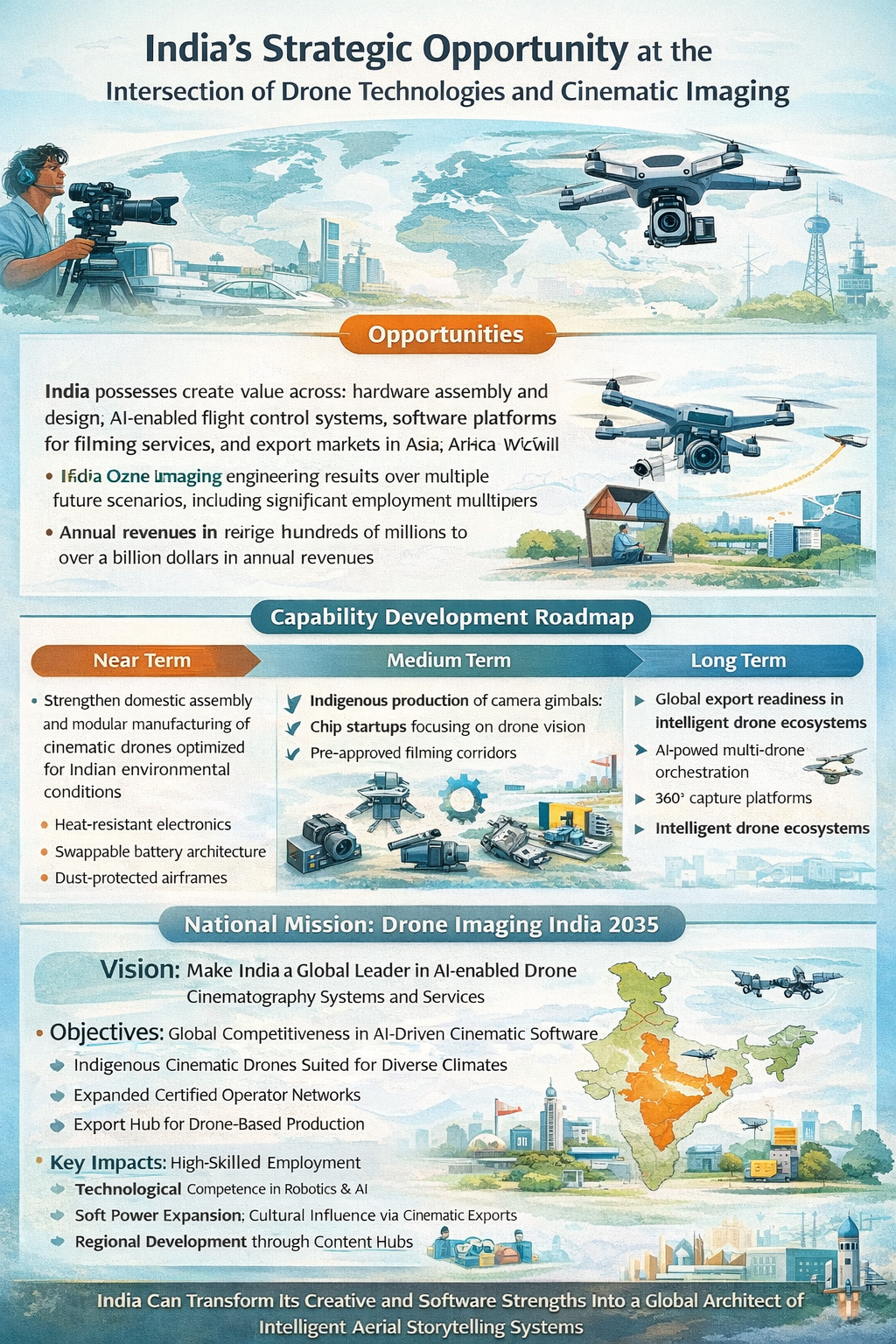
If strategically cultivated, India can capture value across multiple layers: hardware assembly and design, AI-enabled flight control systems, optical and stabilization modules, software platforms for editing and orchestration, service networks for filming, and export markets in Asia, Africa, and the Middle East. Even a modest share of the global imaging segment could generate annual revenues in the range of hundreds of millions to over a billion dollars, with significant employment multipliers in engineering, creative arts, manufacturing, and digital services.
The opportunity, therefore, is not limited to selling drones. It lies in building an integrated Drone Imaging Ecosystem that combines creative economy strengths with advanced technological capabilities.
II. Context
India’s positioning must be understood within a broader technological and geopolitical context. Globally, commercial drone leadership has historically been concentrated in East Asia, particularly in hardware manufacturing. However, the competitive landscape is shifting as software intelligence, AI integration, and regulatory adaptability become more important than pure hardware scale.
Domestically, India has already established progressive drone regulations in recent years under the Directorate General of Civil Aviation. The Production Linked Incentive (PLI) scheme for drones has signaled intent to build domestic manufacturing. Simultaneously, the country’s IT services sector provides a strong base for AI algorithm development, embedded systems programming, and cloud-based orchestration platforms.
However, structural constraints remain. High-end optical sensors and camera modules are still largely imported. Battery density and thermal resilience are technical bottlenecks, particularly given India’s climatic conditions. Regulatory processes, though improved, can still be complex for commercial filming across states. There is also a shortage of certified drone cinematographers and specialized training programs that integrate aviation safety with cinematic technique.
At the same time, demand drivers are intensifying. The growth of OTT platforms, regional content production, influencer marketing, virtual tourism, and infrastructure documentation is creating sustained need for high-quality aerial imaging. Smart city initiatives and urban development programs increasingly rely on visual documentation and digital twins. In tourism, immersive and cinematic promotional content significantly enhances destination competitiveness.
Technological convergence is accelerating. AI-powered edge computing chips are becoming smaller and more energy efficient. Real-time computer vision enables automated framing and tracking. Lightweight composite materials are improving flight endurance. 5G networks enable ultra-low latency video transmission. These trends collectively lower barriers for new entrants who combine hardware assembly with intelligent software.
India’s strategic window lies in leveraging its software strengths and creative industries while progressively indigenizing critical hardware components.
III. Capability Development Roadmap
India’s pathway to leadership requires phased capability development across manufacturing, software intelligence, regulatory systems, human capital, and export positioning.
In the near term, the priority should be to strengthen domestic assembly and modular manufacturing of cinematic drones optimized for Indian environmental conditions. This includes heat-resistant electronics, dust-protected airframes, high-wind stabilization systems, and swappable battery architectures for long-duration shoots. Partnerships between engineering institutes and film schools can foster cross-disciplinary innovation.
Simultaneously, significant investment must be directed toward AI-based cinematography tools. Autonomous subject tracking, gesture-based command systems, programmable cinematic flight paths, and real-time color grading software can become India’s competitive differentiators. Software development can scale more rapidly than deep hardware manufacturing and aligns with India’s established IT ecosystem.
Skill development is critical. A national drone cinematography certification framework should integrate aviation safety, visual storytelling principles, technical maintenance skills, and AI-assisted flight systems. Regional training hubs can ensure accessibility beyond metropolitan centers. As more trained operators enter the market, service costs will decline and adoption will broaden.
In the medium term, domestic production of camera gimbals, stabilization systems, and optical modules must be expanded through targeted incentives and joint ventures. Encouraging semiconductor packaging and embedded system startups to focus on drone-specific chips will deepen technological autonomy. Standardization of pre-approved filming corridors in tourism and infrastructure zones will further reduce operational friction.
In the long term, India should move toward integrated systems leadership. This means multi-drone orchestration platforms capable of synchronized filming, AI-based editing pipelines connected to cloud infrastructure, and immersive 360-degree capture systems compatible with virtual and augmented reality environments. Export branding should position India not merely as a low-cost producer but as a provider of intelligent cinematic drone ecosystems tailored for emerging markets.
Throughout this roadmap, feedback mechanisms must be embedded. Regulatory frameworks should evolve with industry learning. Probability-based risk assessments should inform policy adjustments. Investment flows should prioritize technologies that remain robust across multiple future scenarios, including shifts in security policy or technological disruption.
IV. National Mission: Drone Imaging India 2035
A coherent national mission can unify these efforts under a shared strategic direction. “Drone Imaging India 2035” would aim to establish India as a global leader in AI-enabled drone cinematography systems and services within a decade.
The mission’s vision would be to integrate creative industries, advanced engineering, and digital infrastructure into a unified ecosystem capable of generating export revenue, high-skilled employment, and technological spillovers. Its objectives would include achieving global competitiveness in AI-driven autonomous filming software, developing indigenous cinematic drone platforms suited for diverse climates, expanding certified operator networks, and positioning India as a preferred destination for drone-based production.
The mission could be structured in three stages. The foundational stage would focus on regulatory simplification, pilot creative zones, skill certification rollout, and initial AI software prototypes. The expansion stage would emphasize export development, integration with smart city and tourism programs, and scaling of domestic component manufacturing. The leadership stage would target global brand recognition, immersive media integration, and deployment of synchronized drone systems for international mega-events.
Institutionally, the mission would require coordination among civil aviation authorities, technology ministries, film industry bodies, state tourism departments, startup incubators, and telecom providers. Public–private partnerships would anchor research and commercialization efforts. Dedicated innovation funds could support deep-tech startups working on optics, edge AI chips, and advanced materials.
The broader impact of such a mission would extend beyond direct revenue. It would strengthen India’s soft power through cinematic exports, deepen technological competence in robotics and AI, create employment across creative and technical sectors, and stimulate regional development through distributed content creation hubs.
---
Conclusion
The intersection of drone technology and cinematic imaging is not a peripheral niche; it is a convergence domain where artificial intelligence, optics, telecom, manufacturing, and storytelling meet. For India, the opportunity lies in transforming its cultural creativity and software strength into an integrated technological advantage. By systematically developing capabilities and aligning them under a clear national mission, India can evolve from a consumer of drone imaging technologies into a global architect of intelligent aerial storytelling systems.