
Blog Details
- Member
- March 5, 2026
Proposal for an Interoperable Multi Life Packaging Architecture
Interoperable Multi-Life Packaging Architecture from Srijan Sanchar
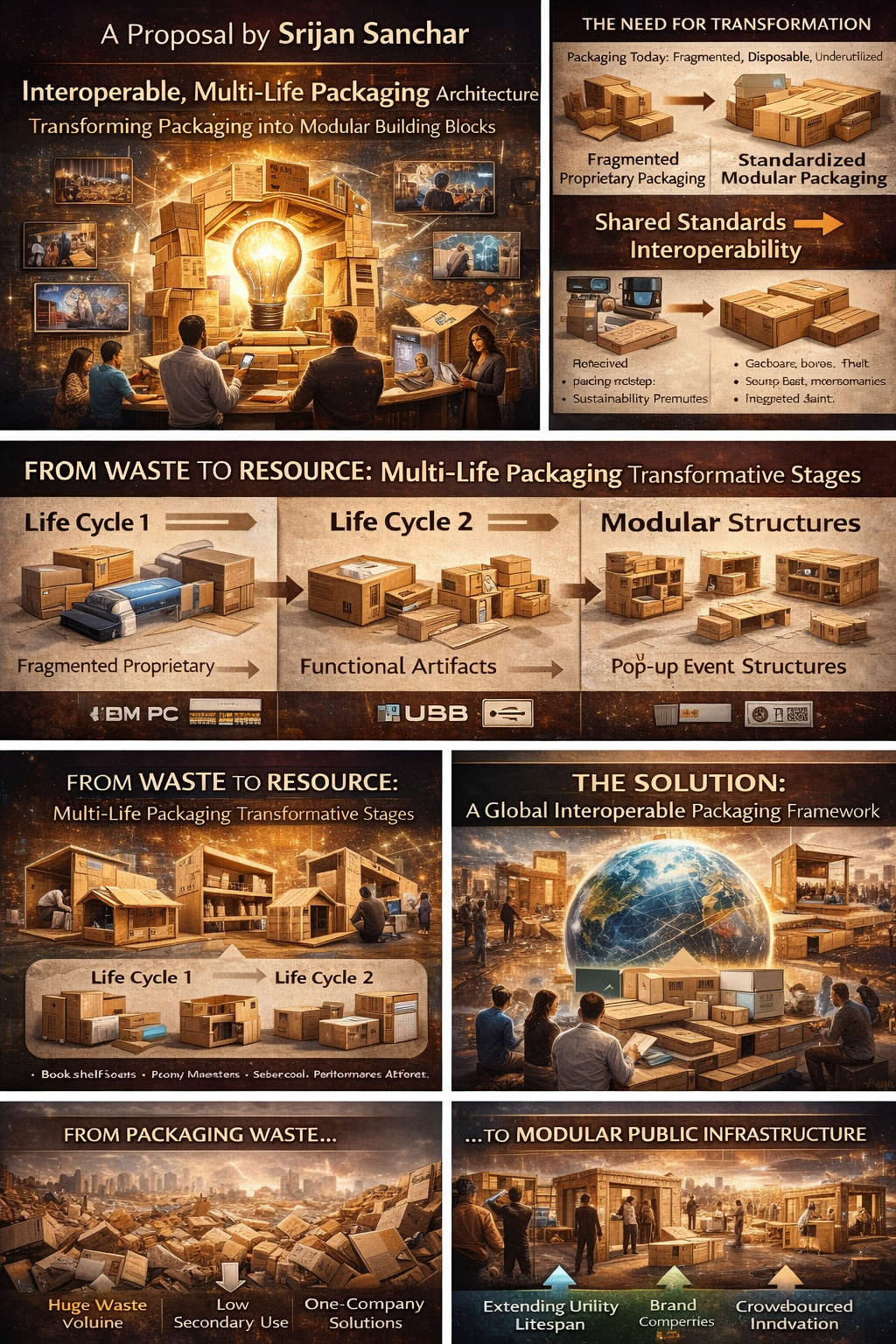
This document Proposal for an Interoperable Multi-Life Packaging Architecture a structured proposal from Srijan Sanchar to industry leaders, policymakers, sustainability advocates, logistics firms, educational institutions, and technology partners. The proposal envisions a coordinated transition from single-use packaging toward an interoperable, multi-life modular system in which packaging from different companies can integrate into durable, useful structures. The ambition is systemic: to transform packaging from a disposable necessity into distributed, regenerative infrastructure.
At present, global packaging systems are optimized almost exclusively for transport protection and cost efficiency. Once the product reaches the consumer, packaging rapidly loses functional value and enters waste or recycling streams. Even where recycling rates improve, the dominant model remains linear. This approach underutilizes the structural potential embedded in corrugated cardboard and similar materials. The problem is not material weakness; it is architectural and institutional fragmentation. Each company designs packaging independently, resulting in dimensional incompatibility that prevents post-use interoperability. Enormous latent structural capacity is discarded daily because there is no shared standard that allows packaging components to work together.
The proposal introduces two mutually reinforcing transformations. First, packaging should be intentionally designed for multiple life cycles. Second, packaging geometry and structural interfaces should follow shared interoperability standards, allowing components from different brands and product categories to interlock and scale into larger artifacts. This mirrors historical transformations in other industries where standardization unlocked ecosystem-level innovation. When computing hardware adopted interoperable architectures—most notably through early PC standardization efforts influenced by IBM—a competitive yet compatible ecosystem emerged. Similarly, interface standards coordinated through bodies such as the USB Implementers Forum allowed products from different manufacturers to function seamlessly together. The packaging sector now stands at a comparable inflection point.
In the multi-life model, packaging is engineered from the outset to move through sequential functional stages. In its first life, it performs conventional protective duties during shipping and storage. In its second life, it transforms into a functional artifact such as a storage container, desk organizer, shelf insert, children’s play module, or small household utility object. In its third life, it participates in modular structural assemblies—bookshelves, partitions, exhibition booths, retail pop-ups, study desks, or temporary relief structures. Only after these utility cycles does it enter the recycling stream. By extending the material’s functional lifespan before reprocessing, environmental impact per utility hour is dramatically reduced without requiring radical material substitution.
The second transformation—the introduction of shared standards—amplifies the first. Today, reuse is isolated and improvised. A consumer may creatively repurpose a box, but integration across brands is virtually impossible because dimensions, slot geometries, and load tolerances vary unpredictably. An interoperable packaging standard would introduce a dimensional grid system, standardized slot and tab geometries, clearly marked strength classifications, and simple metadata tagging for compatibility guidance. Under such a framework, packaging panels from different companies could interlock reliably. A box used to ship electronics could connect structurally with packaging from home goods, apparel, or appliances. The result is a distributed, crowd-sourced construction ecosystem built from the byproducts of commerce.
The systemic value of interoperability cannot be overstated. When products share a structural grammar, network effects multiply utility. Packaging ceases to be proprietary waste and becomes a cooperative infrastructure layer. This shift does not eliminate brand differentiation; surface design, coatings, print identity, and aesthetic treatments remain fully customizable. What changes is the invisible structural backbone that allows components to integrate. The proposal therefore does not erode competitive identity; it enhances collective value creation.
From an environmental perspective, the impact is substantial. Extending packaging life cycles reduces raw material demand, decreases waste volume, and lowers lifecycle carbon intensity. From an economic perspective, companies gain differentiation opportunities through “Interoperable Multi-Life Certified” branding. Secondary markets may emerge for modular add-ons, connectors, reinforcement strips, or aesthetic overlays. Educational institutions could incorporate packaging-based construction kits into design and engineering curricula. Event organizers and disaster response agencies could deploy rapidly assembled temporary structures from standardized modules. The economic ecosystem extends far beyond the packaging manufacturer.
Institutionally, the proposal recognizes that transformation requires coordination. Srijan Sanchar recommends forming a voluntary cross-industry consortium dedicated to packaging interoperability standards. This body would define dimensional grids, slot geometries, structural classifications, and certification criteria. Governance would ensure that standards remain open, adaptable, and technically rigorous. Early adoption could begin with sustainability-driven brands seeking competitive differentiation, followed by expansion through retail procurement policies, public sector endorsement, and educational partnerships. Over time, network effects would incentivize broader participation.
Importantly, this proposal does not depend on speculative technology. The materials, manufacturing capabilities, and digital tagging methods already exist. What is required is structured coordination and intentional evolution. By aligning design incentives, branding strategies, and sustainability narratives, packaging can transition from an isolated protective function to a distributed modular architecture system. The change is evolutionary, not disruptive; it builds on existing supply chains while unlocking new value layers.
The long-term vision is clear. Imagine communities assembling bookshelves, learning kits, temporary walls, and exhibition stands from standardized packaging modules accumulated through everyday consumption. Imagine disaster relief operations deploying rapid shelter systems derived from interoperable packaging collected locally. Imagine educational systems teaching structural engineering principles through real-world modular reuse. The packaging ecosystem becomes participatory, creative, and regenerative.
Srijan Sanchar submits this proposal not as a theoretical exercise but as a call for collaborative design leadership. The environmental imperative is urgent, but the opportunity is equally economic and social. By adopting multi-life design principles and interoperable structural standards, the packaging industry can redefine its role in the circular economy. Instead of optimizing waste management at the end of the lifecycle, we can optimize utility at the beginning.
We invite manufacturers, retailers, logistics providers, policymakers, designers, and educators to join in shaping a Global Interoperable Packaging Framework. Together, we can transform packaging from disposable material into modular public infrastructure—durable across multiple life cycles, compatible across companies, and aligned with the sustainability aspirations of the twenty-first century.
Srijan Sanchar stands ready to convene stakeholders, refine technical specifications, and pilot demonstration projects that validate feasibility at scale. The materials already move through every household on the planet. With shared standards and intentional design, they can also become the building blocks of a regenerative structural ecosystem.