
Blog Details
- Member
- November 14, 2026
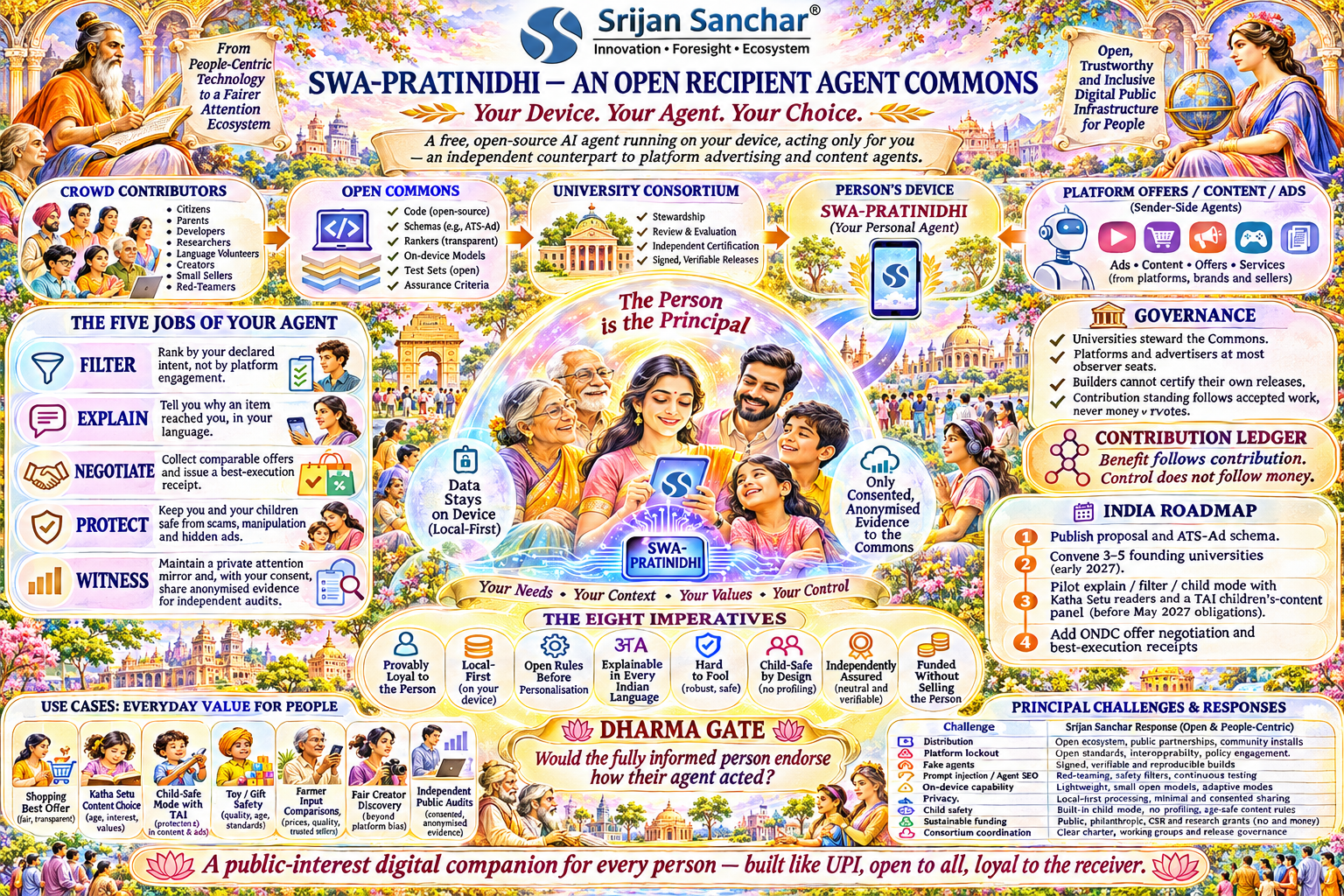
Crowdsourced Open Source Recipient Side Agents
Proposal: Crowdsourced Open-Source
Recipient-Side Agents
Open Recipient Agent Commons
(Swa-Pratinidhi) · Srijan Sanchar · Shailendra Jaiswal · 14 November 2026
Summary
Software
now decides what advertising and content reach people, and almost all of that
software works for the sender. Ad platforms run AI agents that sell attention,
OS-level assistants are becoming the gate to every screen, and content and
advertising are merging into fragments and serial ads. Laws such as India’s
DPDP Act are tightening, but compliance on paper is not protection in practice:
a 2026 audit found TikTok formally compliant with EU rules while still
profiling minors through promotional content.
Srijan
Sanchar proposes an Open Recipient Agent Commons, working name Swa-Pratinidhi,
“one’s own representative”. It is a free, open-source AI agent that runs on a
person’s own device and acts only for them. It filters ads and content by the
person’s declared needs, explains why anything reached them, negotiates offers
and issues a receipt, protects children and blocks manipulation, and, with
consent, contributes anonymised evidence to independent audits. It builds on
Srijan Sanchar’s Open algorithms for attention framework.
Everything
that decides how the agent acts is open: code, schemas, reference rankers,
on-device models, test sets and assurance criteria. Builds are signed and
verifiable so fake agents can be told apart. The crowd (citizens, parents,
developers, researchers, language volunteers, creators and red-teamers)
improves it, rewarded through a contribution ledger where benefit follows
contribution and control does not follow money. A consortium of universities
stewards it, with a stewardship council on which platforms hold at most an
observer seat, and no advertising money funds the agent.
The
promise is an agent every person can check and that costs them nothing, with
fairer reach for creators and small sellers, and a public-interest
counterweight to closed platform assistants, built like UPI. The main
challenges are distribution, platform lockout, fake agents, attacks hidden in
ads, and funding without capture. The first steps are to publish the proposal
and schema, sign up three to five founding universities in early 2027, and
pilot a minimal agent with Katha Setu readers and a TAI children’s-content
panel before India’s children’s-data obligations apply in May 2027.
1. Context
Advertising
and content are now decided by software on the sender’s side, and the receiver
has no equivalent.
•
Agents trade with agents. Ad platforms run AI sellers and buyers; one Indian seller alone
reports 25 trillion predictions a day.
•
Content and ads are merging. Fragments, serial ads and AI-inserted placements blur what counts
as an advertisement.
•
Orchestrators control
access. Feeds, and increasingly OS-level
assistants, decide what reaches a person and capture most of the value.
•
Attention is the scarce
resource. Value of a moment ≈ attention ×
capability to purchase × trust.
•
Paper compliance is not
protection. A 2026 audit of TikTok found formal
compliance with the EU ban on profiled ads to minors, yet promotional content
profiled to minors 5–8 times more strongly than formal ads to adults (KInIT,
FAccT 2026).
•
India has the rails. UPI handled 25.47 billion transactions in October 2026. The DPDP
Rules bring consent managers from November 2026 and children’s-data obligations
from May 2027.
Srijan
Sanchar’s foresight places the ad-funded free model in a pre-threshold state,
five to ten years from breaking (Structural Threshold Foresight). The question
for that transition is whose agent orchestrates what reaches the receiver.
Closed assistants built by platforms will answer it by default unless an open
alternative exists.
2. Imperatives
For a recipient agent to protect people rather than become another
gatekeeper, eight things must be true.
1.
Loyal to the person,
provably. Its objective is declared and its code,
rankers and models are open to inspection.
2.
Local-first. Data and decisions stay on the person’s device; only what the
person chooses is shared.
3.
Open the rules before
personalising the agent. It runs on open standards
and public rails, never inside one platform’s walls.
4.
Explainable in every Indian
language. It can say why anything was shown,
accepted or refused.
5.
Hard to fool. It is protected against prompt injection and “agent SEO” hidden in
ads and product pages.
6.
Safe for children by design. A parent-controlled mode, no profiling, and protection in content
as well as ads.
7.
Independently assured. It is certified by people who answer to receivers, not by those who
build or fund it.
8.
Funded without selling the
person. It never earns money from the data it
protects.
The Dharma gate applies to every release: would the person, fully
informed, endorse how their agent acted for them?
3. Purpose
The
purpose is to give every person in India, and later anywhere, a free, open,
verifiable agent that acts only for them when advertising, offers and content
try to reach them. The crowd improves it and a neutral university consortium
stewards it.

Open
Recipient Agent Commons: crowd, commons, consortium, agent
The
crowd contributes rankers, labels, tests and translations to an open commons.
The consortium reviews, certifies and signs releases. The agent runs on the
person’s device, receives offers and content from platforms, and returns only
consented, anonymised traces that improve the commons.
The
agent has five jobs.
1.
Filter: apply the person’s own ranking (by declared intent, not platform
engagement) to ads, offers and feeds.
2.
Explain: show why each item reached the person, in their language, using
signed reason codes where platforms provide them.
3.
Negotiate: post time-boxed intent windows, collect offers and accept the best,
issuing a best-execution receipt.
4.
Protect: refuse manipulation, block profiling of children, flag unlabelled
ads and scams.
5.
Witness: keep a private attention mirror for the person and, with consent,
contribute anonymised evidence to independent audits.
It
builds directly on Srijan Sanchar’s Open algorithms for attention (the
Open Attention Stack, Attention Trace Schema and reference rankers), and is the
person-side half of the Software-Based Advertising foresight.
4. Open Source
Everything that decides how the agent acts for a person is open.
That makes its loyalty verifiable, and it reaches the top rung of the Open
Algorithms ladder, which platform rankers cannot.
|
What is opened |
Why |
Suggested licence |
|
Agent code (filtering,
explanation, negotiation, protection) |
Anyone can inspect it for
hidden tolls or data leaks |
Apache 2.0 |
|
Schemas: Attention Trace
Schema plus an advertising and offer extension (ATS-Ad), reason-code
codebook, best-execution receipt |
Shared language between
agents, platforms and auditors |
CC BY 4.0 |
|
Reference rankers (R0
chronological, R1 declared intent, R2 commonality-aware, R3
track-record-weighted) |
People can choose or
compare how they are ranked |
Apache 2.0 |
|
On-device models (small,
open-weight, Indian-language capable) |
A closed model underneath
would leak loyalty |
Open-weight licence with a
use policy |
|
Test and red-team sets:
manipulation patterns, unlabelled ads, scams, prompt injections |
Anyone can check the agent
works |
CC BY 4.0, with privacy
screening |
|
Assurance criteria (Dharma
Assurance) |
Certification can be
inspected and challenged |
CC BY 4.0 |
Open code must mean an honest install.
Releases are built reproducibly, signed by the consortium and checkable on the
device, so fake “protective” agents can be told apart. Anyone may fork the
code, but only certified builds may use the protected name and mark.
What stays closed: the person’s data.
Raw traces never leave the device. Only consented, aggregated,
privacy-protected evidence reaches the commons.
Security by openness. Open test sets and
public red-teaming find weaknesses faster than one company could, especially
prompt-injection attacks hidden in ads.
5. Crowd Sourcing
The crowd improves what no single team can: knowledge of local
manipulation tactics, languages, scams and preferences across India. Benefit
follows contribution; control does not follow money.
|
Contributor |
What they contribute |
Example |
|
Citizens and parents |
Report manipulative or
unlabelled ads; donate consented traces; rate explanations |
“This ‘free trial’ ad hid a
subscription” |
|
Developers |
Code, rankers, integrations
with UPI and ONDC apps, security fixes |
A ranker tuned for farmers’
purchases |
|
Researchers and students |
Audits, indices, evaluation
studies, model fine-tuning |
A study of ad load on
low-income users |
|
Language volunteers |
Reason-code translations,
dialect testing |
Explanations in Bhojpuri or
Tulu |
|
Creators and small sellers |
Report unfair ranking; test
offer formats; supply verified product data |
A toy maker flags hidden
self-preferencing |
|
Red-teamers |
Attack the agent with
prompt injection, fake offers, dark patterns |
An ad that tries to
instruct the agent to accept it |
Incentives without corruption. A
contribution ledger records standing for every accepted contribution. Value
realised later (grants, licensing, assurance fees) is shared by standing, with
no per-view payment, standing that cannot be sold, and no votes for money.
Students earn academic credit, researchers get publishable data, and small
sellers get fairer reach.
Quality and integrity.
•
Every contribution is reviewed
by maintainers and, for sensitive areas (children, health, finance), by domain
experts.
•
Integrity checks catch
duplicates, bots and coordinated manipulation.
•
Reputation is earned, and
reviewers’ own contributions are checked by others.
•
Nobody can contribute ads,
sponsorship or paid ranking into the commons.
6. Consortium of
Universities
Universities are the right stewards because they are neutral,
trusted, multidisciplinary and renewed every year by students. A consortium
also spreads the work across India’s languages and regions. India already has
university-led open AI efforts in Indian languages, such as AI4Bharat at IIT
Madras and the BharatGen consortium led by IIT Bombay.
|
Role |
Who (illustrative) |
Responsibility |
|
Convening anchor |
One lead
university, with Srijan Sanchar as originator and secretariat |
Charter,
coordination, releases |
|
Technical labs |
Computer science
and AI departments |
Agent, rankers,
on-device models, security |
|
Law and policy |
National law
universities |
DPDP compliance,
consent design, right to delegate, assurance rules |
|
Behaviour and
society |
Psychology,
sociology, economics, media studies |
Manipulation
patterns, fairness audits, child safety |
|
Language |
Regional
universities and language institutes |
Explanations and
testing in Indian languages |
|
Regional and
teaching partners |
Universities
such as IIMT University, Meerut |
Student
projects, local pilots, curriculum |
|
International
partners |
Universities in
open-source and AI-ethics research |
Cross-checks,
global standards, comparison with other regimes |
Governance.
•
A stewardship council with
defined seats: citizens and parents, creators and small sellers, researchers,
member universities and child-safety experts. Platforms and advertisers hold at
most an observer seat.
•
Separation of roles: those who
build a release cannot certify it; an independent assurance panel does.
•
Open minutes, an open roadmap
and a public register of conflicts of interest.
•
Ledger standing gives a benefit
share, not votes.
Funding. Public research grants and
national AI programmes, CSR and philanthropic funds, and fees for independent
assurance of third-party agents. No advertising or platform money funds the
agent itself; any platform contribution goes only to a blind pooled fund for
audits.
What universities gain. A living
laboratory for AI, law and society; real data under ethical governance; student
projects with public impact; and a share in a national public good.
7. Promise
To
every person: an agent that works for you, that you can check, and that costs
you nothing.
|
For |
The promise |
|
People |
Fewer manipulative ads,
clear reasons for what you see, better offers on your terms, data that stays
with you |
|
Parents and children |
A child mode that blocks
profiling and persuasion in ads and content |
|
Elderly and first-time
users |
A scam shield that explains
risk in their own language |
|
Creators and small sellers |
Fair, explainable reach:
found because you fit someone’s need, not because you paid the gatekeeper |
|
Advertisers who play fair |
Trusted, consented intent,
which converts better than surveillance |
|
Universities |
A national living lab and a
role in shaping AI for the public good |
|
India |
A public-interest
counterweight to closed platform assistants, built like UPI: an open rail
with many apps on top |
In
Srijan Sanchar’s frameworks, the commons is a structural intervention
(Structural Threshold Foresight): it changes who orchestrates rather than
propping up the walled model. It is the only path that keeps Integrity, Impact
and Vitality in balance (HEM), and it moves the CRRAAAS Agent gate to the
person’s side.
8. Possibilities
|
Possibility |
What the agent does |
Pilot partner (illustrative) |
|
Shopping offers |
Posts an intent window
(“school bag under ₹800, this week”), collects offers, accepts the best with
a receipt |
An ONDC buyer app |
|
Feeds and content |
Ranks by declared intent,
shows an attention mirror, flags serial-ad hooks |
Katha Setu readers |
|
Child mode |
Blocks profiling, labels
every ad, parent approves purchases |
Children’s-content panel
with TAI |
|
Toys and gifts |
Checks BIS certification;
lets relatives gift a toy or story without using the child’s data |
TAI members |
|
Peer-to-peer trade |
Verifies vehicle
registration (Vahan) or phone IMEI, holds UPI escrow, checks seller
reputation |
ONDC peer-to-peer pilot |
|
Scam shield |
Spots fake offers and
impersonation, explains risk in local languages |
Elders’ groups, banks |
|
Farmers |
Compares input and
equipment offers, flags inflated prices |
Farmer producer
organisations |
|
Creators |
Shows creators how agents
rank them and why; supports fragment royalties |
Creator collectives |
|
Public audits |
With consent, pools
evidence for independent audits of platforms |
Consortium research panel |
Longer-range possibilities: a national
right to delegate to an agent of one’s choice; ONDC and UPI apps shipping a
certified recipient agent by default; and India exporting the model as a
digital public good, as it has with UPI.
9. Challenges
|
Challenge |
Why it matters |
Mitigation |
|
Distribution |
Most people use the
assistant their phone ships with |
Partner with UPI apps, ONDC
buyer apps and phone makers; seek a public-interest default option |
|
Platform lockout |
Platforms can block agents
through terms or APIs |
Advocate a legal right to
delegate and interoperability rules |
|
Fake agents |
Malicious copies can pose
as protective |
Reproducible signed builds,
a protected mark, on-device verification |
|
Attacks on the agent |
Ads may hide prompt
injections and “agent SEO” |
Open red-teaming, injection
hardening, separation of content from instructions |
|
Capability gap |
Platform AI is far larger |
Shared standards, pooled
crowd intelligence, narrow well-tested tasks |
|
On-device limits |
Low-cost phones have
limited compute |
Small open-weight models;
optional trusted processing without raw data |
|
Funding and capture |
Money can bend priorities |
No ad or platform money for
the agent; seats not for sale; open accounts |
|
Privacy of traces |
Viewing data reveals
religion, politics, health |
Local-first, tiered access,
aggregation thresholds, legal review before pilots |
|
Children |
Highest risk, strictest law
(DPDP from May 2027) |
Parent-controlled mode, no
profiling, independent child-safety review |
|
Consortium coordination |
Universities move slowly
and differently |
Small executive team, clear
charter, Srijan Sanchar as secretariat, rotating chair |
|
Adoption and usability |
Protection is invisible
until it fails |
Visible wins first: scam
shield, child mode, best price found |
First
steps (Thought–Action Network: exploratory first, avoid irreversible bets).
1.
Committed now: publish this proposal and the ATS-Ad schema extension on
srijansanchar.com.
2.
Provisional, early 2027: sign a memorandum with three to five founding universities; form
the stewardship council.
3.
Exploratory, 2027: build a minimal agent (explain, filter, child mode) and pilot it
with Katha Setu readers and a TAI children’s-content panel before May 2027.
4.
Provisional, 2028: add negotiation and best-execution receipts through one ONDC buyer
app, and a peer-to-peer pilot on vehicles.
Hypotheses to test: people understand
signed, localised explanations; the child mode measurably reduces profiled
exposure; crowd red-teaming finds injection attacks faster than an internal
team; small sellers gain fairer reach under intent-based ranking.
Sources
•
Srijan Sanchar, Open algorithms
for attention, October 2026 —
https://www.srijansanchar.com/Blogs/Detail/STORIES/Open-algorithms-for-attention
•
Srijan Sanchar, Software-Based
Advertising foresight compendium and Assurance note, November 2026
•
KInIT, The DSA’s Blind Spot:
algorithmic audit of advertising and minor profiling on TikTok, ACM FAccT 2026
•
NPCI UPI data for October 2026,
via Free Press Journal
•
S.S. Rana & Co., Digital
Personal Data Protection Rules, 2025
•
Srijan Sanchar frameworks:
CRRAAAS, Structural Threshold Foresight, HEM, Thought–Action Network
(srijansanchar.com/blogs)
•
Online version:
https://claude.ai/artifact/PEahxh6w9BrnBQM4yu4fra
University
names are illustrative, not commitments. Mentions of AI4Bharat and BharatGen
are from general knowledge and should be checked before external use. This
proposal is not legal advice.