
Blog Details
- Member
- February 10, 2026
Thought Action Network
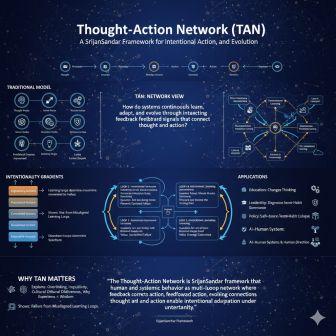
The Thought–Action Network (TAN), a SrijanSanchar framework, fundamentally reimagines human and systemic behavior. Moving beyond the traditional view of a linear progression from thought to deed, TAN conceptualizes behavior as a networked, multi-loop system. In this model, thoughts, actions, intentions, constraints, and learning signals are in a state of constant interaction. Rather than focusing on how a single thought translates into a single action, the framework explores how systems evolve through the interplay of feedback and feedforward signals. This shift is critical for navigating modern environments where uncertainty and complexity render rigid, linear decision models obsolete.
The Network Structure and Core Components
In TAN, the outdated "Thought → Decision → Action" continuum is replaced by a dynamic network where thinking and acting serve as nodes, and learning signals function as the links. The network is composed of five primary node types: Thought Nodes (mental models and beliefs), Intent Nodes (varying levels of commitment), Action Nodes (observable behaviors), Constraint Nodes (real or perceived limits), and Learning Nodes (mechanisms for modification). These nodes are connected by two types of signals: Feedback, which flows from past outcomes to correct current behavior, and Feedforward, which uses anticipation and foresight to shape future direction.
The Multi-Loop Learning Dynamics
Learning within the TAN framework is categorized into eight distinct, interacting loops that operate at various depths. These range from Loop 0 (Reactive Adjustment), which focuses on immediate survival and error correction, to Loop 1 (Efficiency) and Loop 2 (Assumptions), which ask if we are doing things right and doing the right things, respectively. Higher-level loops, such as Loop 3 (Directional) and Loop 4 (Network-Structure), address the "why" of our actions and the very way our thoughts connect to our deeds. Furthermore, loops dedicated to Constraints (Loop 5), Risk (Loop 6), and Distributed Learning (Loop 7) allow the system to explore boundaries, manage commitment thresholds, and externalize cognition for greater resilience and scalability.
Intentionality and System Properties
A key innovation of TAN is the replacement of binary "act or not act" decisions with Intentionality Gradients. By categorizing actions as exploratory, provisional, committed, or irreversible, the framework allows for a more nuanced approach to risk and movement. The system is inherently non-linear and reversibility-aware, acknowledging that action can sometimes precede full understanding and that not all consequences are equal. This results in an evolvable structure that is direction-sensitive, where anticipation shapes behavior as much as correction does.
Impact and Applications
The Thought–Action Network provides a diagnostic lens to explain why organizations repeat mistakes or why experience doesn't always lead to wisdom. It suggests that failure often stems from misaligned learning loops rather than a lack of intelligence. Because of this, TAN has broad applications across diverse fields: in Education, it shifts the focus from performance to changing thought patterns; in Leadership, it identifies where intent has been swallowed by habit; and in AI-Human Systems, it provides a blueprint for aligning machine actions with human direction. Ultimately, TAN serves as a comprehensive framework for intentional adaptation under uncertainty.
Foresight as an Integral Element of the Thought–Action Network
In the Thought–Action Network, foresight functions as a feed-forward intelligence, enabling the system to act not merely in response to the past or present, but in anticipation of emerging possibilities. Unlike feedback, which corrects action after outcomes are visible, foresight operates upstream—shaping thought before it crystallizes into intent and action. It allows individuals and organizations to sense weak signals, emerging patterns, and latent shifts, thereby expanding the decision horizon beyond immediate constraints.
Foresight in TAN is not prediction; it is preparedness of thought. It influences how problems are framed, how goals are defined, and how meaning is assigned to signals from the environment. By inserting future-oriented awareness into the thought phase, TAN ensures that action is not reactive, habitual, or narrowly optimized for short-term gains. Instead, foresight introduces temporal depth, enabling actions that are resilient, adaptive, and aligned with longer-term consequences.
Within the network, foresight also acts as a learning accelerator. When anticipated futures are contrasted with unfolding realities, new feedback loops emerge. These loops do not merely correct behavior but refine assumptions, beliefs, and mental models. In this sense, foresight strengthens higher-order learning—where organizations learn not just what to do, but how they decide what matters. This makes foresight a bridge between reflection and transformation within TAN.
Foresight further enables collective coherence in complex systems. In organizational contexts, it helps align diverse actors around shared images of the future, reducing fragmentation between strategy, operations, and culture. When foresight is embedded in the Thought–Action Network, it becomes a common reference point that connects individual cognition with collective intent, thereby improving coordination without excessive control.
Importantly, foresight in TAN is dynamic, not static. As actions are taken and realities evolve, foresight itself is revised through feedback, dialogue, and reinterpretation. This creates a living network where future images continuously inform present action, and present experience reshapes future imagination. Such a system resists rigidity and remains open to emergence, uncertainty, and novelty.
In essence, foresight gives the Thought–Action Network its directional intelligence. While feedback ensures efficiency and correction, foresight ensures relevance and purpose. Together, they allow TAN to function as a system that learns across time—linking past experience, present action, and future possibility into a coherent and responsible .