
Blog Details
- Member
- January 16, 2026
The RetraSense Initiative
The "RetraSense" Initiative
Domain: Smart Mobility & Urban Safety | Foresight Horizon: 2030
1. The Context: A "Negentropic" Approach to Road Chaos
(Aligned with Srijan Sanchar’s "Negentropic Theory of Cities")
Indian traffic is often viewed as chaotic (high entropy). Traditional solutions—building more flyovers or installing static CCTVs—are expensive and slow. To create order (negentropy) without massive infrastructure spending, we must look at our existing assets differently.
The Insight:
Every day, thousands of public transport buses traverse 90% of our city's arterial roads. They are equipped with rear-view cameras that currently do nothing but help a driver reverse.
What if these "blind eyes" could become the city’s most powerful predictive sensors?
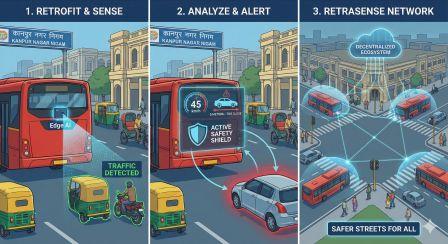
2. The Innovation: RetraSense (Rear-Traffic Sensing Ecosystem)
RetraSense is a proposed decentralized safety system that converts public buses into "Active Safety Shields." By retrofitting existing buses with Edge AI, we can invert the flow of information—using the rear of the bus to analyze the traffic following it.
How It Works (The "Solution Solver" Logic)
The Hardware: Utilizing the existing rear camera + a ruggedized Edge AI box (e.g., NVIDIA Jetson/Orin).
The Intelligence:
Pothole Scanning: As the bus passes a pothole, the rear camera validates it. If 5 buses flag the same GPS coordinate, a "Work Order" is auto-generated for the Municipal Corporation.
Traffic Wake Analysis: Just as a boat leaves a wake, a bus creates a "traffic wake." The AI analyzes the density of trailing traffic to predict gridlocks before they reach the next junction.
V2X Safety Shield: The bus detects a cyclist in its blind spot or a car speeding too fast from behind and flashes an "Adaptive Warning" on its rear LED display (e.g., "SLOW DOWN: HAZARD AHEAD").
3. Strategic Value for Stakeholders
| Stakeholder | Value Proposition |
| City Administration | Zero-Infrastructure Monitoring: A real-time audit of road quality without installing new poles. |
| Bus Operators | Accident Reduction: "Anti-Tailgate" warnings reduce rear-end collisions by an estimated 15-20%. |
| Startups & Academia | Open Innovation Playground: A massive dataset of "Indian Road Conditions" for training autonomous driving models. |
4. Call for Collaboration: "Solution Seekers" & "Problem Solvers"
Srijan Sanchar invites Academia, Startups, and Industry Leaders to collaborate on the following Innovation Challenges:
Challenge A (The Dirty Lens Problem): How can we engineer a low-cost, self-cleaning mechanism for rear cameras using the bus’s existing pneumatic lines?
Challenge B (Privacy-First AI): Develop an Edge AI algorithm that converts video to metadata (e.g., "Car, Speed: 40km/h") instantly, deleting the video frames to comply with the DPDP Act 2023.
Challenge C (The Safety Signal): Design a universal "Rear LED Language" for buses that communicates hazards to trailing drivers without distracting them.
5. The Way Forward
We propose a Pilot "Living Lab" in a Tier-2 city (e.g., Varanasi or Indore).
Phase 1: Retrofit 20 buses on a single high-density route.
Phase 2: Open the data feed to university students to build "Pothole Prediction Maps."
Phase 3: Integrate with Smart Traffic Lights for Green-Wave prioritization.
Join the Discussion:
Is India ready to move from building roads to sensing them? We invite technical experts and policy planners to critique and refine this roadmap.