
Blog Details
- Member
- September 29, 2026
A COMMON SPEED RAILWAY
By Shailendra Jaiswal
A 100 km/h Passenger–Freight Architecture Built Around a
Common 16-Tonne Bogie Platform
A radical idea — or simply an obvious idea seen afresh?
Discussion paper for railway professionals | Working
hypothesis, not an engineering specification
Executive proposition
Indian Railways has historically operated
passenger and freight traffic as different speed classes. Passenger trains are
differentiated by speed; freight trains are frequently fitted around that
faster traffic. This paper asks whether the design problem can be reframed
completely.
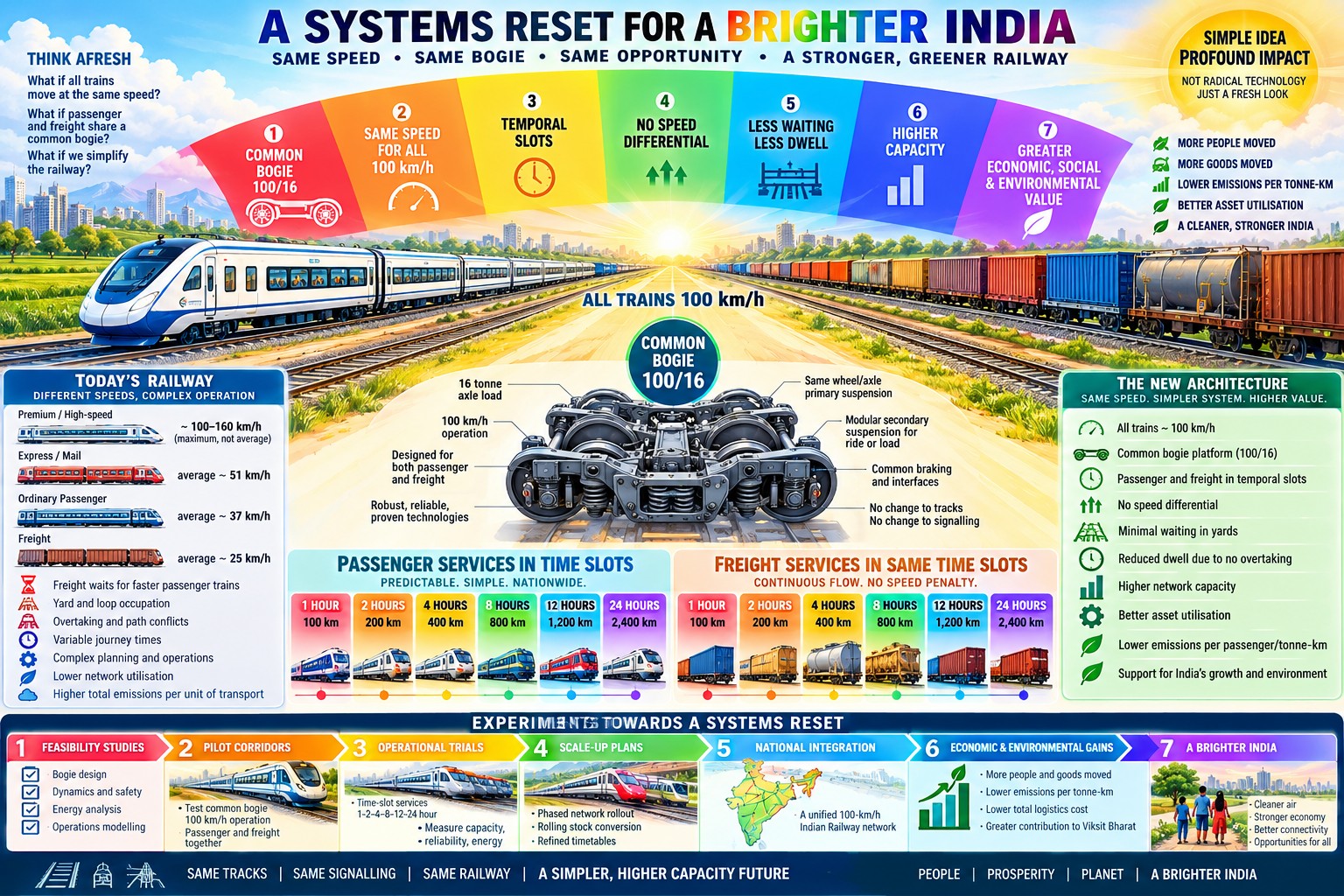
What if the railway adopted a common
operating envelope: a modular common bogie platform designed around
approximately 16 tonnes axle load and 100 km/h operation, with passenger and
freight bodies mounted on appropriate variants of that platform? The purpose
would not be to make every train identical. It would be to make the underlying
movement system much more homogeneous.
The resulting railway would no longer be
organised primarily around slow, fast and superfast traffic. It could instead
be organised around predictable temporal slots: approximately 100, 200, 400,
800, 1,200 and 2,400 km service envelopes corresponding roughly to 1, 2, 4, 8,
12 and 24 hours of running at 100 km/h, before allowances for station and
terminal dwell.
Is the idea really radical?
It is radical at the level of railway
architecture, but much less radical at the level of component engineering.
Indian Railways already operates passenger rolling stock whose specified
maximum axle loads are around 16.25 tonnes, and RDSO specifications cover
bogies operating at speeds substantially above 100 km/h. A current RDSO
specification lists LHB coaches at 16.25 t maximum axle load and 160 km/h
operational speed. citeturn0search25
RDSO material also describes 16.25 t
axle-load wheel and axle arrangements for speeds up to 110 km/h, while other
LHB arrangements extend to 160 km/h. citeturn0search26 The engineering
ingredients therefore already exist in different parts of the railway system.
The genuinely radical question is therefore
not: “Can a railway vehicle run at 100 km/h on a 16-tonne axle?” It is: “Can
passenger and freight rolling stock be designed as variants of a common dynamic
platform, and can the railway timetable be reorganised around a common 100 km/h
movement envelope?”
The central hypothesis: Common Bogie–100/16
The proposal should be treated as a
research hypothesis rather than a prescription for one identical bogie. The
preferred concept is a common bogie architecture with modular adaptations.
|
Common architecture |
Passenger variant |
Freight variant |
|
16-t axle-load envelope |
Ride comfort / secondary suspension |
Payload / load-path optimisation |
|
100 km/h operating envelope |
Passenger ride and noise requirements |
Loaded/empty dynamic requirements |
|
Wheel–axle–bearing family |
Passenger equipment interfaces |
Freight body interfaces |
|
Primary suspension concept |
Enhanced damping where required |
Load-dependent damping |
|
Brake-system interface |
Passenger braking configuration |
Freight braking configuration |
|
Condition monitoring |
Passenger safety/ride monitoring |
Wheel/axle/load monitoring |
This modular-platform approach is
consistent with modern railway bogie engineering. RDSO’s high-speed
specification calls for powered and non-powered bogies to be based on the same
concepts and to use a maximum of identical components, including axle-box and
suspension elements. citeturn0search30
From speed classes to temporal classes
Once passenger and freight trains share the
same operating speed, speed itself ceases to be the principal organising
variable. Service time becomes the more useful variable.
|
Temporal envelope |
Approx. distance at 100 km/h |
Possible service proposition |
|
1 hour |
100 km |
Short intercity / regional |
|
2 hours |
200 km |
Regional intercity |
|
4 hours |
400 km |
Major intercity |
|
8 hours |
800 km |
Long-distance day/night |
|
12 hours |
1,200 km |
Overnight inter-regional |
|
24 hours |
2,400 km |
Long-distance national |
These are theoretical running-distance
envelopes, not promised journey times. Stops, acceleration, terminal operations
and other dwell must still be modelled. The conceptual shift is that a
passenger no longer needs a 160 km/h train merely because the railway has
chosen to differentiate that service by maximum speed. A predictable four-hour
400-km service may be the more meaningful product.
What happens to freight?
The most consequential consequence may be
the disappearance of freight as a slower traffic class. If freight and
passenger trains both move at approximately 100 km/h, the railway can schedule
them in a common temporal sequence rather than continually protecting faster
passenger paths from slower freight paths.
This does not eliminate all freight dwell.
Loading, unloading, marshalling, terminal work, crew procedures and other
operational activities remain. What can potentially be reduced is speed-induced
waiting: holding freight in loops or yards because a faster passenger movement
must pass, or because a freight path is difficult to fit between heterogeneous
speed classes.
The conceptual change is therefore from a
“freight must wait for a faster train” model toward a “freight receives a
temporal movement slot” model.
The railway yard may change its role
If a significant proportion of freight
waiting exists because the network cannot efficiently interleave slow freight
with fast passenger traffic, a common-speed system could reduce the need for
yards to function as holding spaces. Yards could increasingly concentrate on
loading, unloading, consolidation, marshalling and transfer rather than traffic
waiting. This is a hypothesis to be measured, not an assumption to be accepted.
What is gained — and what is sacrificed?
|
Dimension |
Potential gain |
Potential loss / question |
|
Network capacity |
Less speed differential and less path interference |
Actual gain depends on headway, junctions and terminals |
|
Freight cycle time |
Much faster movement and potentially less waiting |
Lower payload per train may reduce tonnes/train |
|
Passenger service |
Predictable temporal slots and potentially higher frequency |
Premium speed differentiation is reduced |
|
Rolling stock |
Common platform, standardisation and fleet flexibility |
New platform validation and transition cost |
|
Energy |
Less idle/waiting and potentially better utilisation |
100 km/h operation can increase traction energy |
|
Environment |
Potential modal shift and lower network congestion |
Energy source and train mass remain critical |
|
Yards |
Potential reduction in speed-induced holding |
Cargo operations still require dwell |
The premium passenger question
The proposal does have a genuine negative
impact: services whose identity and passenger value depend strongly on higher
running speeds would need to be redesigned. This includes the higher-speed end
of intercity services and some premium products.
The relevant question is not simply how
many trains lose speed. It is how many passengers actually lose a valuable
journey-time advantage, and whether that advantage can be replaced by
frequency, reliability, comfort, better station access and predictable temporal
reach. A working hypothesis is that a minority of differentiated premium
services would be materially affected, while the majority of passenger services
could be accommodated within the common-speed architecture. This requires
route-level modelling before any percentage is accepted.
Energy: the necessary counter-test
A common 100 km/h railway does not
automatically consume less energy. Energy depends strongly on speed, train
mass, acceleration, stops, gradients and aerodynamics. The system must
therefore be tested on energy per passenger-km and per tonne-km, not merely
energy per train-km.
There may nevertheless be an important
counter-effect: a train that spends less time waiting or idling may use its
locomotive and network path more productively. Indian Railways material has
highlighted substantial goods-train locomotive idling in diesel operations,
illustrating why waiting time belongs in the energy analysis.
citeturn0search5
Why this may be ‘obvious in hindsight’
·
If two trains use the same
infrastructure, why should one routinely be designed to move at a fundamentally
different speed?
·
If speed differences create
interference, why optimise the individual train rather than reduce the
difference?
·
If freight is delayed because
it is slower, why not improve freight rolling stock until it occupies the same
broad speed envelope?
·
If passenger value is really
about arrival time, why make maximum speed the primary product variable?
·
If a common bogie platform can
reduce rolling-stock complexity, why maintain separate design philosophies
where a modular common architecture is possible?
Seen this way, the proposal is radical
because it questions inherited categories. But each individual question is
quite ordinary. The novelty lies in connecting them into one architecture:
common bogie platform → common axle-load envelope → common operating speed →
common temporal slots → reduced speed-induced interference → potentially higher
network utilisation.
A disciplined engineering programme
1.
Define the Common Bogie–100/16
reference architecture and identify which components can genuinely be common.
2.
Run vehicle–track dynamic
simulations for passenger, empty freight and loaded freight variants at 100
km/h.
3.
Test hunting stability,
wheel/rail forces, curve behaviour, braking, ride quality and suspension
requirements.
4.
Map the present network for
speed-induced freight waiting, overtaking, loop occupation and path conflicts.
5.
Construct a route-level
timetable model with a common 100 km/h movement envelope while holding track
and signalling assumptions constant.
6.
Quantify dwell-time reduction
separately from running-time reduction.
7.
Model passenger temporal slots
of 100/200/400/800/1,200/2,400 km.
8.
Model freight throughput under
different payload assumptions; faster trains do not automatically carry the
same tonnes per train.
9.
Calculate energy per
passenger-km and tonne-km, including acceleration, gradients, stops and
waiting.
10.
Identify corridors where speed
differentiation produces a demonstrable passenger-time benefit and examine
alternative service designs.
11.
Begin with one corridor or
freight-passenger pair as a demonstrator rather than attempting system-wide
conversion.
The proposition in one sentence
Instead
of designing Indian Railways as a network in which different kinds of trains
run at different speeds, test whether it can be designed as a common 100-km/h
transportation platform, built around a modular 16-tonne axle-load bogie
architecture, with passenger and freight differentiated by vehicle purpose and
temporal service slots rather than by fundamental speed class.
Questions for railway experts
·
What is the minimum engineering
change required to create a common 16-t axle-load bogie platform for passenger
and freight variants?
·
What proportion of current
freight waiting is genuinely caused by speed differential?
·
How much network capacity is
released when speed differential approaches zero, holding track and signalling
broadly constant?
·
What freight payload reduction,
if any, is acceptable when cycle time increases substantially?
·
What passenger corridors
genuinely require speeds above 100 km/h to create material passenger benefit?
·
Can the benefits of
standardisation, utilisation and reduced waiting outweigh the loss of premium
speed differentiation?
·
What is the energy and carbon
balance per passenger-km and tonne-km?
·
Which existing corridor could
provide the cleanest real-world pilot?
Closing thought
This paper does not claim that a
common-speed railway is technically, economically or operationally proven. It proposes
that the question is sufficiently grounded in existing railway technology to
deserve engineering analysis. Indian Railways already has passenger rolling
stock at approximately the proposed axle-load envelope, and RDSO specifications
address bogie operation at speeds well above 100 km/h.
citeturn0search25turn0search30
The radical move is to stop asking how to
make each class of train better within the existing architecture and instead
ask whether the architecture itself can be simplified. The idea may therefore
be radical in conception but obvious in hindsight: remove a fundamental source
of incompatibility — different operating speeds — and see what becomes possible
when passenger and freight share the same broad movement envelope.
The appropriate response is neither
acceptance nor rejection. It is a rigorous railway experiment.
Selected technical references
·
RDSO, Specification for metal
bonded rubber components fitted in bogies of Vande Bharat trains and LHB
coaches, 2025.
·
RDSO, High Speed Self-Propelled
Trainset specification, including bogie design and common-component principles.
·
RDSO, technical documentation
showing wheel/axle arrangements for 16.25 t axle load and speeds up to 110/160
km/h.