
Blog Details
- Member
- October 17, 2026
Card Based Gamification of Learning
|
INITIAL DISCUSSION PIECE |
TOY-BASED PEDAGOGY Card-Based Gamification of Learning Seeding a
card-based learning ecosystem for India |
Prepared for
discussion by the Toy Association of India (TAI), with Srijan Sanchar as
Innovation Partner. This is a starting point for conversation, not a finished
plan.
1. Why a Card-Based Track
Toy-based
pedagogy is an established part of Indian education policy. The national
handbook on toy-based pedagogy published in 2022 under the National Education
Policy 2020 treats toys as resources for learning, and places toy-based
pedagogy within play-based learning. At the foundational stage, the Jadui
Pitara learning material already includes flash cards among its toys, puzzles
and playbooks.
Cards offer a
natural entry point for deliberation and practice. They are the lowest-cost toy
format, they can be made and printed in any language, and one deck can carry
very different content, from a chemistry lesson to a game of strategy. They
also span the whole range of thinking, from simple recall to inventing new
games, which makes them well suited to connecting pedagogy, cognition, design
and industry.
Evidence from
classrooms and medical schools is encouraging but mixed. Published studies
report better engagement and, in several cases, learning gains from card games
in chemistry, anatomy, pharmacology and neurology, while at least one study of
high-school chemistry card games found no significant retention advantage over
teacher-led teaching. A focused effort on this theme can help turn scattered
studies into a shared research agenda.
|
Purpose
of this piece To start a
conversation about planting the first seeds of a card-based learning
ecosystem in India: a shared design framework, a small library of prototype
decks, a research and pilot network, and a path into TOYNOVA 2027. |
2. Global Practice and State of the Art
Game-based
learning has grown from a niche practice into a recognised research field, and
cards sit within it. Broad reviews, including a recent meta-analysis in early
childhood education, report moderate to large effects of game-based learning on
cognitive, social, emotional and motivational outcomes, although much of that
evidence concerns digital formats and the authors call for stronger studies.
Non-digital formats have their own growing literature: a recent scoping review
of board and card games in higher education found that most of its 26
qualifying studies reported positive learning outcomes, and a systematic review
of Uno-type card games in mathematics covers research from preschool to
university over several decades. In professional education, card games are used
for chemistry, anatomy, pharmacology and neurology, yet systematic reviews in
fields such as orthodontic education show mixed results and ask for
better-designed experiments. Four themes stand out across this work and current
practice: games designed around a specific learning purpose rather than used
merely as a reward; renewed interest in analogue play, with researchers
examining how generative AI is changing its role; hybrid designs that pair a
printed deck with a low-cost voice or app layer; and a stronger insistence on
evidence, with pretest-posttest and controlled designs replacing anecdote.
India has an unusual combination of strengths, namely a living card tradition
in Ganjifa, a large base of toy-making MSMEs, and national policy support for
toy-based pedagogy. This piece suggests that these are not yet brought together
in a single design framework, and explores what such a framework could look
like.
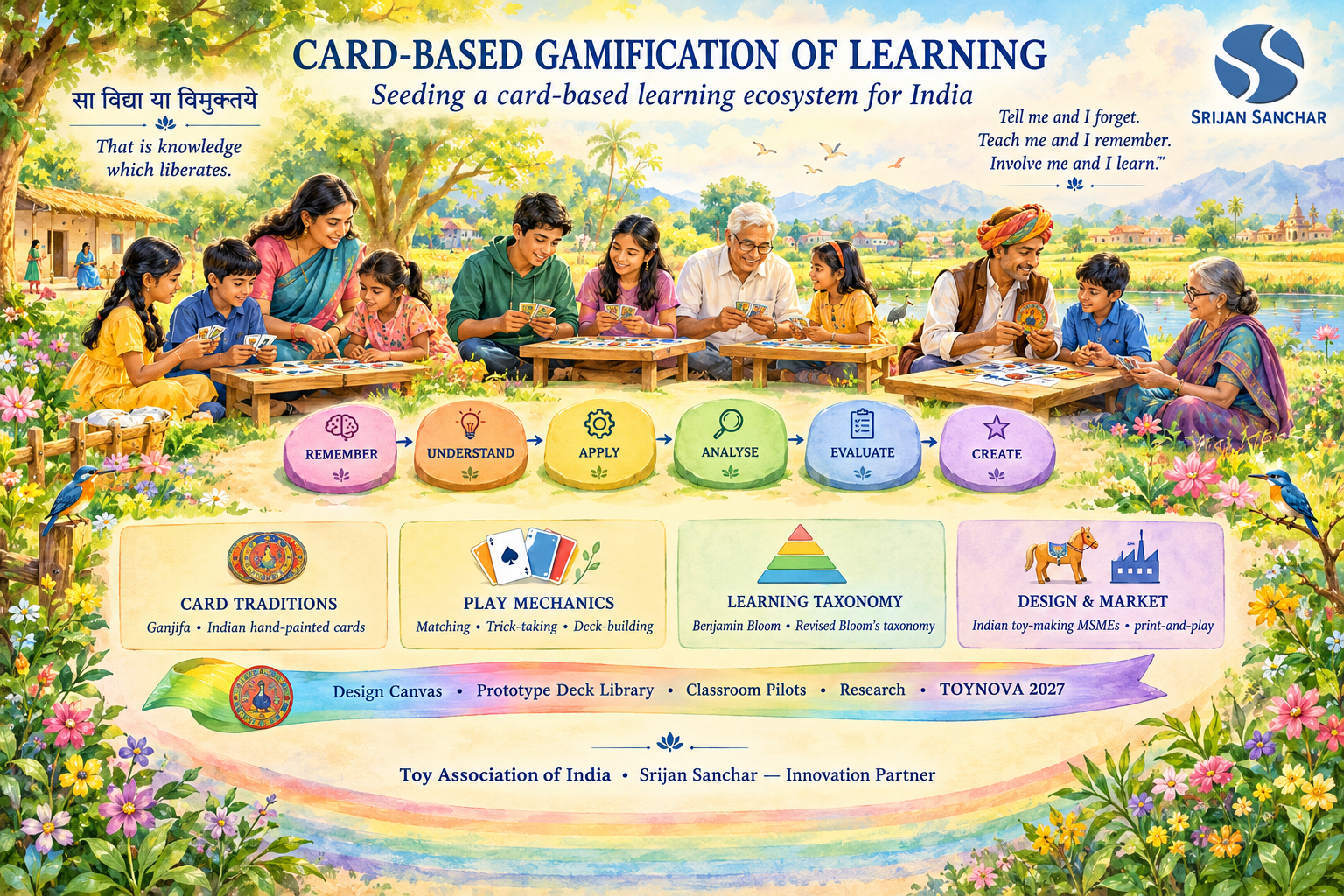
3. A Conceptual Frame A Four Layer Game

Figure 1. The four layers: card families,
play mechanics, learning taxonomy, toy design and market.
•
Card families: the standard 52-card deck,
Ganjifa (the circular hand-painted cards of India), tarot-type decks,
flashcards, matching decks, blank maker decks and deck-building formats.
•
Play mechanics: matching, set-collecting,
melding, shedding, trick-taking, hand-ranking, bluffing and deck-building. Each
demands a different kind of thinking.
•
Learning taxonomy: the revised Bloom's taxonomy
gives six levels, from remember to create. One deck can carry a learner up all
six.
•
Design and market: print-and-play, MSME boxed
decks, craft editions, inclusive editions and low-cost AI layers.

 Figure 2. One deck, six levels: the
learner climbs from playing to making.
Figure 2. One deck, six levels: the
learner climbs from playing to making.
|
A
proposal for discussion: deck grammar A deck
already has the shape of a knowledge structure. Suits can stand for categories,
ranks for depth or difficulty, colour for a yes/no property, court cards for
big ideas, and wild cards for misconceptions and exceptions. Early pilots
could test whether this simple grammar helps teachers and designers build
subject decks quickly. |
4. Objectives
•
Establish card-based gamification as a recognised
strand within toy-based pedagogy research and practice in India.
•
Bring together learning scientists, teacher educators,
subject specialists, designers, artisans and MSME manufacturers around one
practical theme.
•
Co-create a first library of prototype decks and an
open design canvas that others can use.
•
Define a shared evaluation approach so that classroom
pilots produce comparable evidence.
•
Create pathways into pilots, research collaborations, a
possible centre of excellence and TOYNOVA 2027.
5. Possible Seeding Activities
Six linked
activities could form a two-day convening, a workshop series, or a strand
within a larger event. The format is an open question. Durations are
indicative.
|
Slot |
Activity |
Indicative time |
What it delivers |
|
Opening |
Keynote:
Cards as learning toys, from flashcards to design |
30
to 40 min |
Shared
frame: the four layers and the learning ladder. |
|
Early |
Research
session: papers on card-based learning |
90
min |
Evidence
and open questions across subjects and age groups. |
|
Throughout |
Deck
Wall and craft corner |
Open
throughout |
Exhibition
of prototype decks, TOYNOVA concepts (with designers' consent) and Ganjifa
craft demonstration. |
|
Middle |
Card
Lab: hands-on co-design workshop |
2
hours |
Teams
of educators, designers and subject specialists build a prototype deck using
the design canvas. |
|
Late |
Panel:
Does it teach? Evidence, ethics and perception |
60
min |
Research
agenda, evaluation approach, and how to handle the association of cards with
gambling. |
|
Closing |
Seeding
commitments |
30
min |
Institutions
pledge pilots; working groups form; next steps recorded. |
5.1 The Card Lab
The Card Lab is
the seeding heart of the proposal. Participants work in mixed teams, each
choosing a subject and a learning goal, selecting a mechanic, and designing a
small prototype deck on paper. A one-page design canvas guides them: learning
goal, Bloom's level, mechanic, content, components and an inclusion check.
Teams play-test with each other and present in two minutes. Every prototype is
kept as part of the first seed library.
5.2 Possible sub-themes for a call for papers
|
# |
Sub-theme |
|
1 |
Cards
and the taxonomy of learning: mapping mechanics to cognitive levels |
|
2 |
Mathematics,
probability and logical reasoning through cards |
|
3 |
Card
games in science and professional education: chemistry, medicine and health
sciences |
|
4 |
Inclusive
and therapeutic card design for diverse learners |
|
5 |
Heritage
cards, including Ganjifa, in curriculum, craft and cultural learning |
|
6 |
Teacher
education and classroom practice with card-based learning |
|
7 |
Assessment,
evidence and evaluation designs for game-based learning |
|
8 |
Technology
and AI layers for low-cost card games |
|
9 |
Ethics
and perception: separating learning games from gambling |
6. How This Seeds the Ecosystem
|
Seed |
What is planted |
|
Framework |
The
four-layer frame, learning ladder and deck grammar are presented, discussed
and refined with participants. |
|
Design canvas |
A
one-page tool is released openly, so any teacher or designer can create a
subject deck. |
|
Seed library |
Prototype
decks from the Card Lab and the Deck Wall are catalogued, tagged by subject,
mechanic and learning level. |
|
Pilot network |
Participating
institutions volunteer classroom pilots using a shared pre- and post-test
approach. |
|
Research group |
A
working group on card-based learning is formed, with a shared agenda drawn
from the papers and panel. |
|
Industry link |
TAI
members and design talent connect around print-and-play and boxed formats. |
|
Heritage link |
Artisans
and heritage experts take part, with attention to respectful use of
traditional iconography. |
|
Onward pathway |
Selected
concepts are invited to TOYNOVA 2027 as a cross-theme card track, and the
work informs any future centre of excellence. |
7. Roles and Participants
|
Partner or group |
Role in the track |
|
Toy Association of India (TAI) |
Industry
engagement; MSME printers and manufacturers; designer and startup
connections; convening through its exhibitions and TOYNOVA. |
|
Srijan Sanchar (Innovation Partner) |
Framework
and programme design; identification of national and international experts;
synthesis of outcomes; link to TOYNOVA. |
|
Academic and research partners (to be identified) |
Research
programme; classroom pilots; teacher-education linkages. |
|
Subject specialists |
Validate
content in chemistry, mathematics, health sciences, agriculture and other
areas. |
|
Card craftspeople and artisans |
Heritage
demonstrations; advice on traditional card forms. |
|
Educators and students |
Play-test
decks, join the Card Lab, join pilots. |
7.1 Types of resource persons to invite
•
Learning scientists and cognitive psychologists with
experience in game-based learning.
•
Mathematics educators who use cards and probability in
teaching.
•
Authors of published card-game studies in chemistry and
medical education, in India and abroad.
•
Early-childhood and elementary educators familiar with
the national toy-based pedagogy approach.
•
Designers and toy-industry leaders, including TOYNOVA
participants.
•
Ganjifa artisans and heritage researchers.
8. Expected Outcomes and Indicators
|
Outcome |
Indicator |
|
Prototype deck library established |
Number
of decks catalogued, by subject and learning level. |
|
Open design canvas released |
Downloads
and number of educators or designers using it after it is released. |
|
Pilot network formed |
Schools
and colleges committing to classroom pilots; pre- and post-test data
collected. |
|
Research group active |
Joint
proposals or papers within twelve months. |
|
Industry link made |
Concepts
moving to prototype, licensing or production with MSME partners. |
|
Onward pathway used |
Card
concepts submitted to TOYNOVA 2027; input to any centre-of-excellence plan. |
|
Open
points for discussion 1. The right
format: a two-day convening, a workshop series, or a strand within a larger event. 2. Which age
band and subjects to begin with. 3. Which
academic and research partners to approach for pilots and evidence. 4.
Permissions for showing TOYNOVA concepts and for any use of traditional card
iconography. |
9. Sources
•
National
handbook on toy-based pedagogy (2022), prepared under the National Education
Policy 2020.
•
Jadui
Pitara: play-based learning-teaching material for the foundational stage.
•
Alotaibi,
M. S. (2024). Game-based learning in early childhood education: a systematic
review and meta-analysis. Frontiers in Psychology, 15.
•
Analogue
Play in the Age of AI: a scoping review of non-digital games as active learning
strategies in higher education (26 studies; search conducted October 2025).
•
The Role
of Non-Digital and Digital UNO-Type Card Games as Learning Media in Different
Levels of Mathematics Education: a systematic review. Education Sciences, 2025.
•
Sipiyaruk,
K. et al. (2024). Game-based learning in orthodontic education: a systematic
review. BDJ Open, 10.
•
Samuelson,
A. G. (2018). Card Games and Chemistry: Teaching Organometallic Reactions
Through Card Games. Resonance, 23(8).
•
Tursyngozhayev,
K., Kavak, N. and Akhmetov, N. Enhancing Chemistry Education through a Novel
Card Game: Compound Chain.
•
Antibiotic
stewardship card game study. Research and Development in Medical Education,
2025.
•
MedFc
anatomy card game study. Cureus, 2023.
•
Postgraduate
thesis on the design and implementation of card games in high-school chemistry.
•
TOYNOVA
2026 Post-Event Report, Toy Association of India and Srijan Sanchar.