
Blog Details
- Member
- November 24, 2026
From Bansuri to Pranasuri
Aditendra Jaiswal Reimagining Pilibhit as a Global Centre of Music, Innovation and Wellness
A vision for transforming traditional craftsmanship into a knowledge-driven, technology-enabled and globally competitive ecosystem
There are places whose economic destinies are embedded in the skills of their people, the resources of their geography and the traditions inherited across generations. Pilibhit, in Uttar Pradesh, is one such place. Its association with the manufacture of the Indian bamboo flute, the Bansuri, represents more than a traditional occupation. It embodies a remarkable intersection of craftsmanship, music, culture, creativity and human expression. The opportunity before Pilibhit is to rediscover this inheritance, reinterpret it through contemporary knowledge and technology, and transform it into a globally competitive economic ecosystem.
The central proposition is simple but transformative: Pilibhit should not remain merely a place where flutes are manufactured. It should aspire to become a place where the future of flutes, musical instruments, musical toys, music-enabled learning and wellness applications is imagined, researched, designed, manufactured and commercialised. Such a transformation would reposition a traditional product as the foundation of a diversified knowledge economy.
Rediscovering the Bansuri as Pranasuri
The Bansuri occupies a distinctive position in India's cultural imagination. Associated with Lord Krishna, it represents harmony, tranquillity, devotion and the relationship between human beings and nature. Its simplicity conceals considerable sophistication. A hollow bamboo tube, carefully selected and processed, becomes an instrument capable of producing an extraordinary range of musical expressions through the coordination of breath, fingers, hearing and concentration.
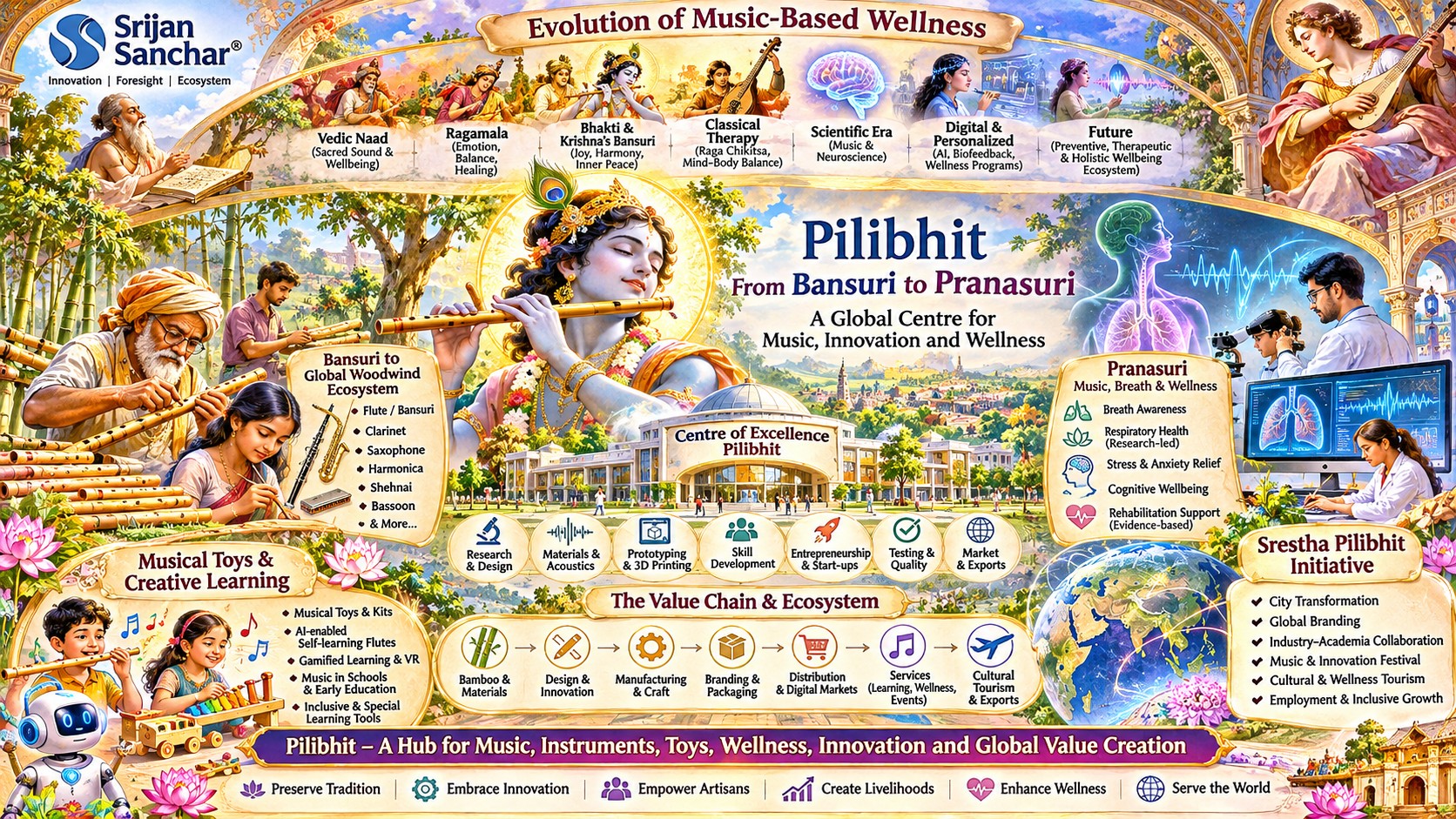
This relationship between breath and music offers the conceptual foundation for the idea of Pranasuri. The term signifies a possible evolution of the Bansuri from an exclusively musical instrument into an instrument that also encourages conscious breathing, attention, respiratory awareness and wellbeing. Playing the flute requires controlled exhalation, coordination and sustained concentration. These characteristics create opportunities to investigate its relationship with pranayama, contemplative practices, music education and selected wellness interventions.
Pranasuri should therefore be developed as a research-led proposition integrating music, respiratory science, yoga, psychology, neuroscience and medical research. Rather than making premature claims about diagnosis or treatment, the objective should be to establish scientifically validated applications through carefully designed studies. The long-term possibility is to develop structured breathing and music programmes, assisted learning instruments and evidence-based wellness applications that can serve different age groups and user communities.
This repositioning creates an important conceptual shift: the value of the flute would no longer be measured only by the number of instruments manufactured or sold, but also by the knowledge, experiences, services and new applications generated around it.
From a Traditional Cluster to a Global Instrument Industry
Pilibhit already possesses an important foundation in the skills associated with bamboo and reed-based instrument manufacturing. This accumulated knowledge can become the starting point for diversifying into a broader family of wind instruments. Clarinets, saxophones, harmonicas, shehnais, bassoons and other reed-based or wind instruments represent possible directions for exploration, subject to the acquisition of appropriate technical capabilities and specialised skills.
Such diversification would require a systematic understanding of acoustics, material science, precision manufacturing, instrument geometry and quality standards. The development of natural bamboo and cane components alongside suitable synthetic materials could create opportunities for innovation in durability, consistency, tonal performance and affordability. Material scientists, acoustic engineers, instrument designers and experienced musicians could jointly develop new products and manufacturing processes.
The ambition should be to build a complete value chain within and around Pilibhit. Bamboo selection, treatment, component production, instrument design, precision drilling, tuning, finishing, testing, packaging, branding, distribution and after-sales services should become interconnected activities. This would generate opportunities for existing artisans while creating new employment for designers, engineers, technicians, musicians, digital marketers and entrepreneurs.
The global market should be approached not merely as an export destination but as a source of design intelligence, technology partnerships and continuous product improvement. International musicians, instrument manufacturers, music schools and distributors can become collaborators in the evolution of Pilibhit's manufacturing capabilities.
The Emergence of a Musical Toy and Creative Learning Economy
One of the most promising opportunities lies in extending Pilibhit's capabilities into musical toys and educational instruments. Children encounter music naturally through rhythm, sound, repetition and play. Musical toys can therefore become powerful instruments for developing auditory perception, coordination, creativity, pattern recognition and early cognitive abilities.
Pilibhit can develop an integrated portfolio of affordable musical toys, beginner flutes, rhythm instruments, interactive sound devices and educational kits. These products could be designed for different age groups and learning environments, including homes, schools, preschools and special learning settings.
Technology can significantly expand this opportunity. AI-enabled learning platforms could provide guided instruction, feedback on basic playing techniques and personalised learning pathways. Sensors could help identify pitch, rhythm, breath intensity and finger coordination. Interactive applications, virtual environments and gamified learning experiences could make the process of learning music more engaging.
The integration of traditional craftsmanship with electronics, software, digital fabrication and contemporary product design could give Pilibhit a distinctive position in the global musical toy industry. The opportunity is not simply to manufacture more toys, but to create an ecosystem that connects music, learning, play, technology and cultural expression.
Technology as an Enabler of Traditional Knowledge
The future competitiveness of Pilibhit will depend on its ability to combine traditional knowledge with contemporary technological capabilities. Computational fluid dynamics can help investigate airflow and instrument performance. Acoustic analysis can improve tonal consistency and support the development of new instrument designs. Three-dimensional printing can enable rapid prototyping of components and complex geometries. Advanced materials research can expand the possibilities of bamboo, cane, polymers and composite materials.
Digital design platforms can help artisans translate traditional design knowledge into reproducible production specifications. Artificial intelligence can support design exploration, quality assessment, learning applications and customer engagement. Internet-connected sensors may be incorporated into selected instruments to measure playing parameters and provide feedback.
Technology should not displace the artisan. Its purpose should be to enhance the artisan's capabilities, improve product quality, reduce avoidable waste and enable the development of products that would otherwise be difficult to manufacture. The artisan's accumulated tacit knowledge must become an important input into the innovation process.
A particularly valuable opportunity lies in developing a digital design bank and knowledge repository documenting instrument designs, materials, manufacturing processes, acoustic characteristics and best practices. Such a repository could preserve traditional expertise while making it accessible to new generations of designers and entrepreneurs.
A Centre of Excellence for Flute-Based Innovation
A dedicated Centre of Excellence in Pilibhit could become the institutional anchor for this transformation. It should not function merely as a training centre or manufacturing facility. Its mandate should encompass research, design, prototyping, testing, skill development, entrepreneurship, market intelligence and international collaboration.
The proposed Centre could have interconnected programmes covering instrument design and acoustics, bamboo and synthetic materials, musical toys, digital manufacturing, music education, breathwork and wellness research, and commercialisation of innovations.
It could host an annual international flute and music festival, research conferences, design competitions, artisan workshops and innovation challenges. Academic projects undertaken by universities and design institutions could be connected with actual industrial problems. Start-ups could use shared prototyping facilities, testing infrastructure, design studios and common production resources.
The Centre should also develop a systematic research agenda. This would include documenting existing capabilities, identifying unmet market needs, mapping global instrument technologies, studying material innovations, understanding consumer preferences and forecasting future opportunities. A structured taxonomy of flute-based innovations could help identify emerging patterns and new areas of application.
An especially important function would be to convert research into commercially viable products and services. The Centre must therefore connect researchers with manufacturers, entrepreneurs, investors, musicians and international buyers.
Building an Integrated Institutional Ecosystem
The transformation of Pilibhit cannot be achieved by individual manufacturers or government programmes working in isolation. It requires a coordinated institutional architecture.
A triple-helix model involving educational institutions, industry and Srijan Sanchar can provide the foundation. Government agencies and local administration can facilitate infrastructure, policy support and institutional coordination, while musicians, artisans, designers, technology companies and entrepreneurs contribute specialised knowledge and market connections.
The proposed Srestha Pilibhit initiative could serve as a collaborative platform for mobilising these stakeholders around a shared development vision. Its role would be to establish strategic priorities, facilitate partnerships, monitor implementation and promote Pilibhit nationally and internationally.
The concept of Sangeet Sahkarya Sthal, or a collaborative music and making space, deserves particular attention. Shared facilities for musicians, artisans, designers, students and entrepreneurs could lower the cost of experimentation and enterprise creation. Common workshops, studios, digital fabrication facilities and demonstration spaces could enable individuals with complementary capabilities to work together.
This would help transform isolated skills into collective capabilities and create opportunities for new enterprises, particularly among younger generations.
Unlocking the Wider Economic Potential of Pilibhit
The economic impact of this transformation would extend beyond flute manufacturing. A globally recognised music and innovation destination could generate demand for hospitality, tourism, transport, cultural performances, educational programmes, exhibitions and specialised services.
Pilibhit could develop a distinctive cultural tourism proposition around the Bansuri, its manufacturing traditions and its relationship with Indian music. Visitors could experience the process of making a flute, participate in music workshops, attend performances and explore the cultural significance of sound and breath.
The district could also create a strong place-based brand linking craftsmanship, music, innovation and wellness. This brand would provide a narrative for domestic and international markets and differentiate Pilibhit from competing manufacturing locations.
A systematic value-chain approach would help identify where economic value is currently created, where it migrates outside the district and which capabilities need to be developed locally. The objective should be to increase the share of design, intellectual property, technology, branding, distribution and service value retained within the district.
This is the larger promise of the One District One Product philosophy: transforming a district's traditional strength into a platform for entrepreneurship, employment, regional prosperity and global competitiveness.
A Phased Roadmap for Transformation
The journey should begin with a comprehensive assessment of Pilibhit's existing manufacturing ecosystem, artisan capabilities, market linkages, infrastructure and institutional resources. This should be followed by design and development programmes, technology demonstrations, skill upgradation and the creation of shared innovation facilities.
The next phase should focus on product diversification, quality improvement, common testing standards, digital marketing, e-commerce and national and international market access. Simultaneously, the Centre of Excellence should initiate research partnerships and establish programmes in musical toys, instrument innovation and evidence-based music and wellness applications.
The subsequent phase should consolidate international collaborations, attract investment, encourage start-ups, establish an international music festival and position Pilibhit as a destination for instrument design, production, learning and cultural tourism.
Progress should be measured through meaningful indicators: artisan incomes, skilled employment, new enterprises, product diversity, design registrations, research collaborations, market access, export performance and the proportion of value added within the district.
Dream in Pilibhit, Create in Pilibhit, Reach the World
The transformation of Pilibhit offers a larger lesson for India's development strategy. Traditional industries need not remain confined to low-value manufacturing. With the right combination of knowledge, design, technology, institutional collaboration and entrepreneurship, they can become the foundations of sophisticated industrial and creative ecosystems.
The Bansuri is an especially powerful starting point because it connects the material world of bamboo and craftsmanship with the intangible world of sound, emotion, culture and human consciousness. Its reinvention as Pranasuri opens a research frontier; its extension into musical toys creates an opportunity in education and creative industries; and its integration with modern design and manufacturing offers a pathway to global competitiveness.
The aspiration should be to make Pilibhit a place where traditional knowledge is respected, artisans are empowered, young people find opportunities, researchers discover new possibilities and entrepreneurs build enterprises for global markets.
Dream in Pilibhit. Think in Pilibhit. Design in Pilibhit. Innovate in Pilibhit. Produce in Pilibhit. Learn in Pilibhit. Heal through evidence-based innovation. Perform for the world. Sell everywhere.
The journey from Bansuri to Pranasuri is ultimately a journey from inherited skill to institutionalised knowledge, from a traditional product to a diversified innovation ecosystem, and from local craftsmanship to global value creation. It is an opportunity to make Pilibhit not merely famous for what it has produced in the past, but indispensable for what it can create in the future.
An initiative articulated by Srijan Sanchar.