
Blog Details
- Member
- September 30, 2026
Problem Solver Solution Seeker Exchange
An Integrated Framework for Problem Discovery, Solution
Generation, Cross-Domain Innovation, Experimentation and Impact
Concept Document — Working
Architecture | Version 2.0
| September 2026
Status of this document.
This is a working architecture: a set of hypotheses about how structured
problem-solving methods, distributed capabilities and a learning system might
combine. It is not a report of validated results. Effects attributed to
frameworks are labelled [H] (hypothesised) and each is tied to a metric
(Section 14) and to the pilot design (Section 13). Version 2.0 revises Version
1.0 following a structured review; the changes, and the items awaiting author
confirmation, are listed in Appendix B.
1. Executive Proposition
The Srijan
Sanchar Problem Solver–Solution Seeker Exchange is a digital and human
innovation infrastructure. It connects organisations that have problems
(Solution Seekers) with researchers, faculty, students, startups, experts,
innovators and other actors who hold relevant knowledge, capabilities, ideas or
resources (Problem Solvers).
Its existing
proposition is direct: Seekers bring real-world problems; Solvers bring
solutions. The proposed next stage is broader. The Exchange becomes an
orchestration system in which problems are structured, reframed and decomposed;
matched with distributed capabilities; explored from multiple perspectives;
transformed through cross-domain knowledge; tested; implemented
collaboratively; and converted into reusable innovation knowledge.
Problem → Solver → Solution becomes
Problem → Structure → Perspectives → Capabilities → Ideas →
Recombination → Experiment → Validation → Implementation → Impact → Learning
Three
commitments shape this version:
•
Honesty about novelty. Consistent with Srijan
Sanchar’s principle of no false representation of novelty, the document does
not claim that its primitives are new. The claim is a testable combination
(Section 2).
•
Honesty about evidence. Every framework enters
the Exchange as a hypothesis to be tested, not an assured capability (Sections
7 and 13).
•
An institution, not only an idea. An Exchange
must work as a trusted, funded and governed organisation, so trust, IP,
governance and operating model are treated explicitly (Sections 11 and 15).
2. Positioning and Prior Art
Problem-broadcast
and open-innovation challenge platforms already exist, for example
InnoCentive/Wazoku, NineSigma, HeroX and Innoget. So do technology-scouting
marketplaces (for example Yet2), contest platforms (for example Kaggle and
Topcoder), expert-network and research-profile systems, and public innovation
programmes. This list is indicative, not a completed survey. Against that
background, the elements of this architecture divide as follows.
|
Element |
Established practice
(borrowed) |
What this architecture
proposes (to be tested) |
|
Problem intake |
Challenge briefs posted by Seekers |
A structured Problem Passport, with
framing, prioritisation and partitioning completed before broadcast |
|
Solver
discovery |
Open
call; profile or keyword search |
Capability
Passports; structural as well as keyword matching; bidirectional search |
|
Ideation support |
Facilitated workshops,
brainstorming, TRIZ-type methods, morphological analysis |
A tiered framework path with
built-in comparative testing (MPMA, AXIM, PAC, isomorphism, RISE) |
|
Collaboration |
Winner-takes-prize
contests; consulting engagements |
Solution
constellations; recorded Contribution → Combination → Outcome |
|
Evaluation |
Judging panels |
Grounding, coherence and value
gates; blind independent scoring in the research pilot |
|
Learning |
Case
studies; post-project reviews |
Success
Mode Records, FMSA and Innovation Memory feeding a staged knowledge graph |
Position.
The components are largely known. The candidate distinctiveness lies in the
combination, especially structural matching, the tiered framework path with
comparative testing built in, and the learning system. That is itself a
hypothesis.
Discipline
before any external claim. A formal prior-art search is to be run using the
grounding discipline of Probabilistic AXIM v2: each element is classified as
Known/Established, Emerging/Contested, or Grounded White Space, and only the
last supports a novelty claim. Until then, external communication should
describe the Exchange as a combination of established and new methods offered
for testing.
3. The Fundamental Shift: One Canonical Flow
Version 1
stated the flow several times with different orderings. Version 2 uses one
canonical flow of five phases, shown below. Phases iterate: exploration can
return to framing, and a well-framed problem may enter at Explore or Mobilise.
Direction B (Section 9) enters from the capability side.

Two
different tests are kept apart. The RISE-based *structural stress test*
asks whether an insight survives breakdown, regeneration and perturbation,
before costly work begins. The *experiment* asks whether it works in reality.
Version 1 called both “validation”; Version 2 does not.
4. Participants and Service Tiers
|
Role |
Function |
|
Solution Seeker |
An organisation, MSME, government
body, corporation or other entity seeking a solution. |
|
Problem
Solver |
A
researcher, faculty member, student, startup, expert, entrepreneur or
innovator able to respond. |
|
Problem Interpreter |
Converts an inadequately defined
problem into a structured problem and prepares the Problem Passport. |
|
Innovation
Orchestrator |
Connects
capabilities, perspectives, experiments and actors; assembles solution constellations. |
|
Validation / Implementation Partner |
Provides laboratories, manufacturing
capability, field environments, finance, IP support, incubation or market
access. |
|
Independent
Evaluator (new) |
Scores
submissions at the gates and in the research pilot. Does not contribute to
what is being scored and is not an author of the frameworks under test. |
The same
individual or organisation can occupy several roles, with one restriction: no
one evaluates a submission they contributed to, and Interpreters and
Orchestrators disclose their interests in an engagement.
Service
tiers. Human Interpreter and Orchestrator capacity is scarce, so it is
itself allocated by leverage (the Recursive Pareto principle applied to the
Exchange’s own resources).
|
Tier |
What the Seeker
receives |
Suited to |
|
1. Guided |
Self-serve, AI-assisted framing and
the standard path; human review at gates only |
Routine or lower-leverage problems;
high volume |
|
2.
Interpreted |
A
human Interpreter prepares the Passport and runs the standard path |
Moderately
complex problems |
|
3. Orchestrated |
Full orchestration: constellations,
experiments, implementation partners |
High-leverage, partitioned problems |
5. Passports: Problem and Capability
5.1 The Problem Passport
Every significant
challenge entering the Exchange acquires a Problem Passport.
•
Identity: problem ID; owner; sector; geography;
scale.
•
Situation: observed phenomenon; desired outcome;
current condition; known causes; unknown causes; constraints.
•
History: existing solutions; previous attempts;
failed attempts.
•
Resources and value: available assets; missing
capabilities; economic, social and environmental value.
•
Terms: time horizon; technology readiness; IP
status; success criteria; required expertise; potential collaborators;
experiment possibilities; reward or opportunity.
•
Disclosure tier (new): which fields are visible
to whom (Section 11). Framing status (new): draft, reviewed or approved;
approval is Gate G1.
5.2 The Capability Passport
A conventional
CV describes what a person has done. A Capability Passport describes what a
person can contribute, and states how strongly each claim is evidenced.
•
Domain and technical expertise; research, prototype and
experimentation capability.
•
Equipment, laboratory and manufacturing access;
software, materials and previous solutions.
•
Problems previously solved (described by structure as
well as by topic; see Section 9); available time and location.
•
Collaboration preference; commercialisation and IP
capability; mentoring and cross-domain interests.
•
Evidence level (new): self-declared; endorsed by
a peer or institution; or evidenced by prior work or a verified test.
Personal and
organisational data. Passports contain personal and commercial information.
Consent, purpose limitation and access control are required, and legal review
against applicable law, including India’s Digital Personal Data Protection Act,
2023, is needed before launch.
6. The Role of AI
Version 1 did
not say where AI sits. Version 2 adopts a human–AI division of labour: the
human supplies purpose, judgement, values and selection; the frameworks supply
explicit cognitive structure; AI supplies abundant generation. The frameworks
then make intermediate structures (alternatives, tests, failures, invariants)
visible to humans for review, challenge and correction.
This is the Intelligence
Legibility principle: implicit AI capability should become visible,
inspectable, challengeable, traceable and governable. It is not the same as
exposing an AI system’s internal computation.
|
Task |
AI assistance |
Human decision |
Legibility requirement |
|
Passport drafting |
Draft Problem and Capability
Passports from documents or interviews |
Owner confirms |
Fields marked AI-drafted or
owner-confirmed |
|
Framing
and partitioning |
Propose
alternative framings and partitions |
Interpreter
selects |
All
alternatives retained in the record |
|
Perspectives, analogies, axes |
Generate source domains, analogies
and candidate axes |
Facilitator curates |
Provenance of each item logged |
|
Candidate
matching |
Propose
matches at keyword, structural and isomorphic levels |
Orchestrator
approves |
Match
rationale displayed |
|
Prior-art check |
Search and classify |
Evaluator confirms |
Sources and rights flag stored |
|
Structural
stress test |
Run
breakdown and regeneration probes |
Evaluator
judges |
Probe
results shown |
•
No AI-generated item enters a Solution Portfolio
without passing the grounding gate and human sign-off.
•
AI contributions are recorded in the Contribution
Ledger distinctly from human contributions.
•
The research pilot includes AI-only comparison arms
(Section 13), so the frameworks are tested against AI practice, not only
against unaided practice.
Open
question. In AI-abundant conditions the value of generating ideas may fall.
The Exchange’s durable value may lie more in framing, grounding, matching,
testing and implementation, where human and institutional roles remain. The
pilot should watch for this.
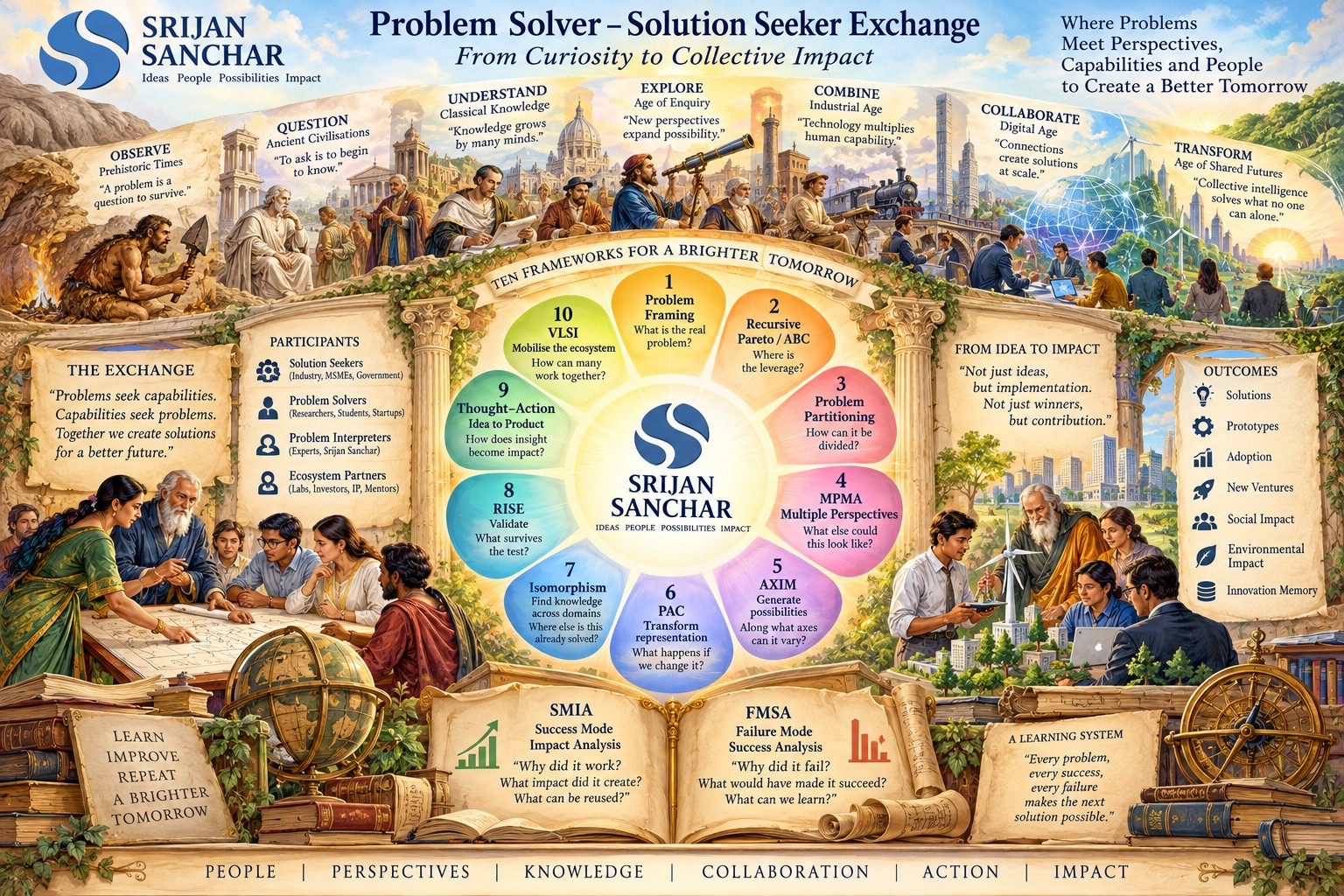
7. The Ten Frameworks
The ten
frameworks are of uneven maturity. Version 2 states the maturity of each and
arranges them in tiers, so that no Seeker is required to use all ten. Maturity
legend: M0 concept; M1 documented working methodology; M2 applied in real
cases; M3 comparatively validated. None has yet been comparatively validated
inside the Exchange, so every effect below is a hypothesis [H]. The
maturity ratings are provisional (Appendix B).
|
No. |
Framework |
Question and role in
the Exchange |
[H] Effect and metric |
Maturity / tier |
|
1 |
Problem Framing |
What is the real problem worth
solving? Moves from observation to gap, causes, perspectives, reframing and
an actionable problem. |
Better problem statements; less
wasted solver effort. Metric: Passport quality score; solver clarification
queries; share of problems reframed. |
M1 · Standard |
|
2 |
Recursive
Pareto / ABC / Double-A Analysis |
Where
is the leverage? Concentrates attention on high-value elements while
recognising the limits of over-concentration. Also allocates the Exchange’s
human capacity (Section 4). |
Higher
leverage per unit of search effort. Metric: share of eventual value traceable
to prioritised elements (retrospective). |
Base
technique M3; Srijan extension M1 · Standard |
|
3 |
Problem Partitioning |
How can a complex problem be divided
into solvable structures? Creates subsystem, interface and integration
problems as separate opportunities. |
More entry points for specialists;
easier collaboration. Metric: distinct contributors per partitioned problem;
sub-problem solve rate. |
M1 · Standard |
|
4 |
MPMA
— Multiple Perspective through Multiple Analogy (2013) |
What
does the problem look like from other domains? Multiple source domains are
structured first and applied to the target afterwards. |
Wider
idea diversity. Metric: Perspective Yield against baseline arms. |
M2
· Standard |
|
5 |
AXIM — Autonomous Axis Identification
Methodology, with Probabilistic AXIM (Grounded Surprisal) |
Along what independent dimensions
can the problem vary? Derives problem-specific axes. The grounding gate
(Section 8) is its prior-art discipline. |
Larger structured possibility space.
Metric: axes accepted by experts as independent; configurations surviving the
grounding gate. |
M1 · Experimental arm |
|
6 |
PAC
— Projective Analytic Continuity |
What
whole could account for this partial observation, and what if the problem is
represented differently? Supplies representation-transforming operators
(shifting, inversion, decomposition, recombination, translation, boundary
change). |
Reframing;
new solution architectures. Metric: accepted new representations; Perspective
Yield; downstream implementation. |
M1
· Experimental arm |
|
7 |
Isomorphism-Enabled
Interdisciplinarity
(ICDIDF) |
Where does another discipline
already hold the same underlying structure? Searches for structural
equivalence, not surface similarity. Also drives structural matching (Section
9). |
Unexpected capability discovery.
Metric: structural-match acceptance against keyword baseline; cross-domain
transfers realised. |
M1 · Experimental arm |
|
8 |
RISE
— Recursive Invariant Synthesis for Essence |
What
survives? In the Exchange it serves as the structural stress test: breakdown,
regeneration and stability under perturbation. |
Fewer
false positives reaching costly experiments. Metric: false-positive rate at
experiment stage; agreement between RISE robustness and later outcomes. |
M1
· Experimental arm |
|
9 |
Thought–Action / Idea-to-Product
Continuum (incl.
Thought-Action Network) |
How does insight become
implementation? Pathway from thought through concept, design, prototype and
experiment to deployment, with feedback loops. |
Fewer engagements ending at
ideation. Metric: Cognitive Conversion Rate; stage-to-stage drop-off. |
M1 · Standard |
|
10 |
VLSI
— Very Large Scale Innovation |
How
can distributed capabilities work together? Builds solution constellations
across industry, academia, startups, laboratories, investors and
implementation partners. |
Coordinated
capacity from individual contributions. Metric: constellation completion
rate; time to pilot. |
M1
· Conditional (partitioned problems needing three or more contributor types) |
Tiers.
The standard path (1, 2, 3, 4, 9) applies to every engagement. The experimental
arms (5, 6, 7, 8) are assigned by the research design (Section 13) so that
their contribution can be measured. Framework 10 is conditional on
problem structure.
8. Stage Logic, Artefacts and Gates
|
Stage |
Purpose |
Frameworks |
Output artefact |
Gate |
|
S1 Intake and framing |
Establish the real problem |
1 |
Problem Passport (draft to approved) |
G1 Passport quality |
|
S2
Prioritise and partition |
Locate
leverage; create tractable units |
2,
3 |
Ranked,
partitioned problem map |
— |
|
S3 Explore |
Perspectives, axes, transformations,
structural search |
4, 5, 6, 7 (by tier) |
Perspective set; axis set; candidate
structures |
— |
|
S4
Mobilise |
Match
and assemble contributors |
7,
10 |
Match
list; constellation plan |
Orchestrator
approval with match rationale |
|
S5 Portfolio and grounding |
Consolidate solutions; check prior
art |
5 |
Solution Portfolio classified Known
/ Emerging / Grounded White Space |
G Grounding gate |
|
S6
Structural stress test and recombination |
Separate
robust from merely attractive |
8 |
Stress-test
report; recombined candidates |
C
Coherence gate |
|
S7 Experiment and empirical
validation |
Test in reality |
9 |
Experiment protocol and results |
V Stakeholder value gate |
|
S8
Implementation |
Deploy
and adopt |
9,
10 |
Pilot
or deployment record |
Seeker’s
adoption decision |
|
S9 Learning |
Record and learn |
SMR, FMSA, SMIA |
Success Mode Record; failure record;
Innovation Memory entry |
— |
Gate
definitions. The gates follow the design of the insight-generation process.
•
Grounding (G) is a hard constraint on what the
Exchange may say about a solution, not a weighted score. Each candidate is
classified as Known/Established, Emerging/Contested (closing fast) or Grounded
White Space. Only the last may be described as new. Known items carry a source
and rights flag.
•
Coherence (C): the candidate is internally
consistent and survives the structural stress test.
•
Stakeholder Value (V): value to the named
stakeholder, plus an externalities check beyond the named stakeholder.
9. The Bidirectional Exchange and Structural Matching
Direction A
— Problem → Capability: “I have a problem. Who can help solve it?” Direction
B — Capability → Problem: “I have a capability. What problems can it
solve?” Together they make the word *Exchange* substantive: problems seek
capabilities, and capabilities seek problems.
Version 1
asserted that the Exchange could match Problem Structure with Capability
Structure rather than keyword with keyword. Version 2 treats that as the
hardest technical claim and specifies it as three levels:
|
Level |
Basis of match |
Role |
|
L1 Attribute |
Keywords, domains, equipment,
location, availability |
Baseline; always run |
|
L2
Structural |
The
problem’s partition, constraints and axes compared with the structure of
problems the capability holder has previously solved |
Tested
against L1 |
|
L3 Isomorphic |
A contributor from a different
domain who has worked with the same underlying structure |
Tested against L1 and L2 |
Levels L2 and
L3 require a minimal shared structural vocabulary in both Passports
(phenomenon, constraints, partition interfaces, axes). Hypothesis H-M:
L2 and L3 matching surfaces qualified contributors that L1 misses, at
acceptable precision. Test: run L1 alongside L2 and L3 on pilot problems
and compare match acceptance and the contributions that reach the Solution
Portfolio, under blind review. Fallback: if the vocabulary proves too
costly to maintain, retain L1 with human-curated structure tags.
10. Solution Constellations and the Contribution Ledger
A complex
challenge may need a conceptual insight, engineering capability, laboratory
validation, startup prototyping, industrial manufacturing and investment. The
Exchange therefore records Contribution → Combination → Outcome rather than
Winner → Prize.
|
Contributor |
Contribution |
Stage |
Evidence |
Outcome |
|
Industry |
Problem |
Framing |
Problem Passport |
Challenge |
|
Researcher |
Structural
insight |
Explore |
Submission |
New
concept |
|
Student |
Analogy |
Explore |
MPMA record |
Design change |
|
Laboratory |
Experiment |
Experiment |
Test
result |
Evidence |
|
Startup |
Prototype |
Development |
Prototype |
Pilot |
|
Manufacturer |
Scale-up |
Implementation |
Production
record |
Deployment |
|
Independent Evaluator |
Scoring |
Gates |
Score sheet |
Gate decision |
|
AI
tool (recorded distinctly) |
Generation
or search |
Any |
Provenance
log |
Candidate
items |
From record
to recognition. The ledger is a record. How contributions are recognised or
rewarded is a separate mechanism. The Contribution Ledger Model (a threshold
gate combined with a realisation share, developed for the TOYNOVA 2027
proposal) is the candidate mechanism, pending testing in the Exchange. Two
design notes carry over. Contributions differ in kind (conceptual,
experimental, developmental, manufacturing, capital), so a single scalar weight
is unlikely to suffice. Early trust-building interactions should not be priced
or tokenised in ways that undermine that trust.
11. Trust, IP, Confidentiality and Governance
•
Tiered disclosure. Each Passport field carries a
disclosure tier. Illustrative tiers: T0 public signal (sector, need,
opportunity); T1 structured summary for registered users; T2 detail released
after agreement; T3 full detail restricted to selected contributors. To be aligned
with the Opportunity Commons tiered-disclosure model.
•
IP principles. Default positions for each
engagement type are published in advance. Background and foreground IP are
distinguished. A contributor’s submission remains theirs unless assigned by
agreement, and the Seeker’s data remains the Seeker’s. Ledger entries are evidence
of contribution, not a transfer of rights. Standard agreements require legal
counsel.
•
Innovation Memory access. Memory entries follow
the same disclosure tiers as their source Passports. The knowledge graph learns
from anonymised structural patterns, not from confidential content.
•
Conflicts of interest. Interpreter, Orchestrator
and Evaluator roles are separated for any given engagement, and interests are
disclosed.
•
Governance. An advisory body drawn from Seekers,
Solvers, academia and legal expertise; published rules; a dispute-handling
procedure; periodic audit of gate decisions.
•
Data protection. As Section 5.2.
12. The Learning System
12.1 Success Mode Record (SMR) and SMIA
Version 1 used
the acronym SMIA for a per-engagement table. Version 2 separates the data from
the analysis. The Success Mode Record is completed for each engagement. Success-Mode
Impact Assessment (SMIA) is the framework-level analysis run across
records: it asks where a framework creates measurable advantage rather than
whether it “works”. It uses seven candidate success modes (Understanding,
Creation, Transformation, Communication, Decision-making, AI augmentation,
Discovery), three impact levels (Cognitive, Generative, Outcome), an
alternative-practice test comparing current practice, framework-assisted
practice and AI-plus-framework practice, and a falsification requirement: for
every claimed benefit, try to show the framework was unnecessary.
|
SMR dimension |
Question |
|
Problem |
What was being solved? |
|
Intervention |
What
was actually done? |
|
Framework |
Which Srijan Sanchar method was
used, at which stage? |
|
Perspective |
What
new view changed the problem? |
|
Capability and combination |
Who contributed, and which capabilities
were recombined? |
|
Experiment
and decision |
What
was tested, and what caused adoption? |
|
Impact |
What changed? |
|
Time
and cost |
How
long did it take and what resources were required? |
|
Replicability and spillover |
Can it work elsewhere, and what other
problems can it address? |
|
Counterfactual
(new) |
What
would current practice or an AI-only approach likely have produced? |
12.2 FMSA
Failure Mode
Success Analysis is used at two points. *Prospectively* (as published): a
project is deconstructed into modules, failure modes are identified for each,
and the alternative success paths each module could yield even if the overall
project fails are scored. In the Exchange this runs before spend at S4 and S7.
*Retrospectively* (an extension proposed here): when an attempt fails, the
record captures the failure mode, the underlying condition, the success
condition that would have been necessary, the relevant framework response and
the improved protocol. Example: a technology works technically but cannot be
manufactured economically. Instead of recording “solution failed”, the record
captures the manufacturing-cost condition and the protocol change that would
surface it earlier.
12.3 The learning loop and Innovation Memory
Exchange activity → success or failure →
SMR / FMSA → success mechanisms and failure conditions → SMIA → knowledge
update → framework improvement → better next problem
The Exchange
maintains a permanent Srijan Innovation Memory recording: the problem
and initial assumptions; reframing and subsequent understanding; search and
solver selection; perspectives and frameworks used; ideas generated and
selection rationale; experiments and results; success and failure modes;
contributions and contributors; outcome and impact; and transferability to
other problems.
12.4 From records to a knowledge graph, in stages
|
Stage |
Content |
Proceed when |
|
0 Structured records |
Passports, SMRs, FMSA records,
ledger entries in consistent formats |
Records are complete and actually
used in later engagements |
|
1
Linked graph |
Problems,
phenomena, constraints, frameworks, perspectives, capabilities, people,
laboratories, technologies, solutions, experiments, success modes, failure
modes, applications and markets, linked by typed relations |
Stage
0 data quality is verified and disclosure tiers are enforced |
|
2 Inference and recommendation |
Suggested matches, framework paths
and likely failure modes for new problems |
Recommendations outperform the L1
and human-only baselines in the pilot |
13. The Exchange as a Research Laboratory
Every problem
is an opportunity to learn which framework works, in which type of problem,
under what conditions, at what stage and with what measurable impact. Version 1
stated this aim; Version 2 specifies how it would be done.
13.1 Research questions
•
RQ1. Does the standard path improve problem
quality relative to conventional intake?
•
RQ2. Do the experimental arms (AXIM, PAC,
isomorphism, RISE) raise Perspective Yield beyond the standard path, and for
which problem types?
•
RQ3. Does structural matching find qualified
contributors that keyword matching misses?
•
RQ4. Does the RISE stress test reduce false
positives before experiment?
•
RQ5. Does the framework-assisted path improve
implementation rate and impact against the alternatives, including AI-only
practice?
13.2 Design
•
Comparison arms: (a) current practice; (b)
generic AI prompting; (c) expert prompting or facilitation without Srijan
frameworks; (d) standard path; (e) standard path with AI; (f) standard path
plus experimental framework(s) with AI. Not every arm runs on every problem; arms
are allocated across matched problem classes.
•
Allocation: random or matched-pair assignment
within problem classes, with the class recorded in the Problem Passport.
•
Blind independent scoring: evaluators who are
not framework authors and do not know the arm, using a scoring sheet agreed in
advance. Ideas are scored after the grounding gate.
•
Pre-registration: metrics, thresholds and stop
rules are written down before the pilot begins.
•
Falsification requirement: for each claimed
benefit, the evaluation actively tries to show the framework was unnecessary.
•
Scale caution: a small pilot gives indicative,
not conclusive, evidence. Results are reported with uncertainty and are subject
to independent review, since the framework set is largely single-author.
•
Participants: informed that they take part in a
comparative study; confidentiality preserved.
14. Metrics
|
Family |
Metric |
Operational definition |
|
Input |
Coverage |
Problems, solvers, capabilities,
disciplines and organisations registered. |
|
Process |
Framing
and matching |
Problems
framed and partitioned; perspectives generated; matches proposed and
accepted. Match Precision = accepted matches ÷ proposed matches,
reported by level (L1, L2, L3). |
|
Conversion |
Cognitive Conversion Rate (CCR) |
Actionable innovations ÷ registered
engagements, measured at a fixed horizon (for example 12 months). An
*actionable innovation* passes gates G, C and V and has a named
implementation owner with committed resources. The denominator includes every
registered engagement, abandoned ones too. Reported by problem class and
service tier. |
|
Conversion |
Funnel |
Shortlisted
solutions, prototypes, pilots, adopted solutions, commercialised
technologies, startups formed. |
|
Learning |
Perspective Yield (PY) |
Independently rated useful solution
directions ÷ structured perspective interventions. *Useful* means scored
above a pre-agreed threshold in blind scoring and not classified Known
at the grounding gate. Reported per intervention and per facilitation hour,
and compared across arms. |
|
Learning |
Knowledge
growth |
Success
modes and failure records logged; framework refinements; reusable insights;
cross-domain transfers realised. |
|
Impact |
Outcomes |
Cost reduction, revenue,
productivity, social and environmental outcomes, jobs, IP and cluster-level
effects; Seeker-reported and independently verified where feasible. |
15. Operating Model and Pilot Phasing
15.1 Funding options (decision open)
•
Seeker fees by service tier.
•
Anchor sponsors, such as industry bodies and government
programmes.
•
Grants and academic funding for the research pilot.
•
Success-linked shares through the ledger mechanism
(Section 10).
•
Solver-side services such as mentoring and IP support.
15.2 Cold start
Begin with a bounded
community around an existing programme where Seekers and Solvers already
gather, for example the TAI–Srijan Sanchar TOYNOVA design challenges, in one or
two sectors. Seed Capability Passports from existing participants, and run
Direction B early so that Solvers see value before large numbers of Seekers
arrive.
15.3 Phasing
|
Phase |
Focus |
Outputs |
Decision gate |
|
0 Foundation |
Prior-art search; terminology lock;
legal templates (IP, disclosure, data protection); scoring sheets; pre-registration |
Prior-art classification;
agreements; protocol |
Prior-art and legal review complete |
|
1
Controlled pilot |
A
bounded set of real problems (indicatively 10–20) in one or two sectors, with
arms allocated per Section 13; Tier 2–3 service |
Passports,
SMRs, ledger entries, blind-scored results |
Pre-agreed
criteria met; independent review of results |
|
2 Extension |
Broaden sectors; add Tier 1 Guided
service using the frameworks that proved worthwhile; refine matching |
Service catalogue; matching
performance data |
Unit economics and Match Precision
acceptable |
|
3
Knowledge graph and network |
Stage
1–2 graph; recommendations; wider governance |
Graph;
recommendation service |
Memory
quality and governance verified |
16. Risks and Open Questions
|
Risk |
Why it matters |
Mitigation |
|
Framework overload for Seekers |
Ten frameworks may intimidate or
slow Seekers |
Tiered path; Seekers see outputs
rather than method |
|
Human
capacity bottleneck |
Interpreters
and Orchestrators are scarce |
Service
tiers; leverage-based allocation; legible AI assistance; training |
|
Structural matching proves
impractical |
The shared vocabulary may cost too
much |
Keep L1 baseline; curated tags; test
early |
|
Circular
evaluation |
Framework
authors scoring their own outputs |
Independent
blind evaluators; pre-registration |
|
Over-claiming novelty or effect |
Credibility and integrity |
Prior-art gate; [H] labelling;
status statement |
|
IP
and confidentiality disputes |
Loss
of trust |
Tiered
disclosure; standard agreements; legal counsel |
|
Flood of low-quality or AI-generated
submissions |
Signal dilution |
Grounding gate; evidence levels;
submission limits |
|
Cold
start |
Too
few Seekers or Solvers |
Anchor
programme; Direction B first |
|
Single-author dependence |
The framework set is largely from
one source |
Independent adversarial review;
compare against alternative methods such as TRIZ-type and generic
morphological analysis |
|
Innovation
Memory leakage |
Memory
may hold confidential content |
Tiered
access; anonymised patterns only |
Open
questions. (1) What minimal structural vocabulary can Passports share? (2)
Which problem classes benefit from which frameworks? (3) Which funding model
fits which sector? (4) How should recognition differ across kinds of
contribution? (5) Does the value of ideas hold up in AI-abundant conditions,
and if not, where does the Exchange’s value sit?
17. Strategic Proposition and Core Thesis
The Exchange
should not be positioned merely as a platform for finding solutions. Its
candidate deeper proposition is an innovation operating system for
converting distributed knowledge into validated action, offered as a
hypothesis for testing. Any distinctive capability would come from combining
Problem Intelligence, Perspective Intelligence, Capability Intelligence,
Cross-Domain Intelligence, Experimentation, Validation, Contribution
Recognition and Innovation Memory.
The Exchange
begins with “I have a problem. You may have a solution.” It then evolves: “We
have a problem. Let us understand it better.” “Let us see it differently.” “Let
us discover who, anywhere, understands some part of its structure.” “Let us
combine those capabilities.” “Let us experiment.” “Let us understand why it
succeeded or failed.” And finally: “Let us make what we learned available for
the next problem.”
PROBLEM → INSIGHT → POSSIBILITY →
COLLABORATION → EXPERIMENT → SOLUTION → IMPACT → LEARNING → NEW POSSIBILITY
The ultimate
value of the Exchange is not the number of solutions it produces. It is the
increasing problem-solving capacity of the network. A successful Exchange
becomes more intelligent with every problem, solver, analogy, experiment,
success, failure, contribution and implementation. The destination is the
Srijan Sanchar Innovation Exchange:
Where problems become structured,
capabilities become visible, perspectives become combinable, experiments become
possible, contributions become recognisable, and every success and failure
becomes knowledge for the next innovation.
Next step.
Complete Phase 0 (prior-art search, terminology lock, legal templates,
pre-registration), then run the controlled pilot in Section 15 and measure
problem quality, solution diversity, solution validity, implementation rate and
impact against the comparison arms. The Exchange can thereby become the
empirical laboratory for a Srijan Sanchar Framework of Frameworks.
Appendix A. Terminology Register
|
Term |
Full name or definition
used here |
Note |
|
PAC |
Projective Analytic Continuity |
Version 1 expanded it as
“Perspective-Transform and Operator Architecture”; corrected. |
|
AXIM |
Autonomous
Axis Identification Methodology; Probabilistic AXIM (Grounded Surprisal, v2) |
Version
1 expanded it as “Morphological Axis Methodology”; corrected. |
|
RISE |
Recursive Invariant Synthesis for
Essence |
Used here as the structural stress
test; the wider essence-finding methodology is unchanged. |
|
MPMA |
Multiple
Perspective through Multiple Analogy (2013) |
Distinct
from Structural Analysis (formerly “MPMA v0.1”). |
|
SMIA |
Success-Mode Impact Assessment |
Framework-level evaluation. Version
1 expanded it as “Success Mode Impact Analysis” and used it for
per-engagement data. |
|
SMR |
Success
Mode Record |
New
in Version 2; the per-engagement data that SMIA analyses. |
|
FMSA |
Failure Mode Success Analysis |
Prospective use as published;
retrospective use is an extension proposed here. |
|
Success
Mode Analysis |
The
inverse-FMEA loop in NPD 2.0 |
A
distinct construct; not used in this document. |
|
TAN |
Thought-Action Network |
Underlies Framework 9. |
|
VLSI |
Very
Large Scale Innovation |
Not
the chip-design term; expanded on first use. |
|
ICDIDF |
[Expansion to be confirmed by the
author] |
Version 1 gave the acronym only. |
|
Contribution
Ledger |
A
record of Contribution → Combination → Outcome (Section 10) |
Distinct
from the Contribution Ledger Model (threshold gate plus realisation share). |
|
Opportunity Commons |
Tiered-disclosure signal model |
Referenced in Section 11. |
|
Intelligence
Legibility |
The
degree to which implicit AI capability becomes visible, inspectable,
challengeable, comparable, traceable, reproducible, teachable and governable |
Section
6. |
|
CCR, PY |
Cognitive Conversion Rate;
Perspective Yield |
Defined in Section 14. |
Appendix B. Change Log and Items for Author Confirmation
B.1 Changes from Version 1.0
|
# |
Version 1 issue |
Version 2 change |
|
1 |
Terminology conflicted with
published definitions (PAC, AXIM, SMIA, FMSA, RISE; unexpanded ICDIDF and
VLSI) |
Corrected throughout; Appendix A
register added |
|
2 |
Impact
arrows (↑↑↑) asserted unvalidated effects; status statement came last |
Status
statement moved to the front; arrows replaced by [H] hypotheses with metrics
(Section 7) |
|
3 |
“Validation” used for both
structural testing and experiment |
Structural stress test and empirical
experiment separated (Sections 3 and 8) |
|
4 |
Research-laboratory
claim had no design; metrics undefined |
Research
questions, arms, blind scoring and pre-registration (Section 13); operational
metric definitions (Section 14) |
|
5 |
No prior-art or positioning section |
Section 2, with a prior-art gate before
any novelty claim |
|
6 |
Institution
missing: funding, cold start, capacity, trust, IP, governance |
Sections
4, 11 and 15 |
|
7 |
Ledger was a table only |
Linked to the Contribution Ledger
Model and Opportunity Commons (Sections 10 and 11) |
|
8 |
AI
absent |
Section
6, with Intelligence Legibility and AI-only comparison arms |
|
9 |
Structure–structure matching
asserted |
Specified as three levels with a
hypothesis, test and fallback (Section 9) |
|
10 |
Flow
chain repeated four times; closing sections repeated each other |
One
canonical flow with diagram (Section 3); former Sections 31–33 merged into
Section 17 |
|
11 |
Frameworks presented as uniformly
ready |
Maturity ratings and standard /
experimental / conditional tiers (Section 7) |
B.2 Items awaiting author confirmation
•
ICDIDF: the full expansion.
•
Maturity ratings (M0–M3) and tier assignments in
Section 7 are provisional.
•
Framework 6: Version 1 listed the transformation
operators (shifting, inversion, decomposition, recombination, translation,
boundary change) under “PAC / Perspective-Transform and Operator Architecture”.
Version 2 keeps the list under PAC. Please confirm whether these belong to PAC,
to the Framework of Perspectives, or to another operator set.
•
VLSI: Version 2 retains Version 1’s description;
a fuller definition would help.
•
Disclosure tiers in Section 11 are illustrative
and should be reconciled with the Opportunity Commons model.
•
Pilot size (10–20 problems) and the 12-month CCR
horizon are indicative.
•
Prior-art list in Section 2 is indicative; the
formal search remains to be done.