
Blog Details
- Member
- September 30, 2026
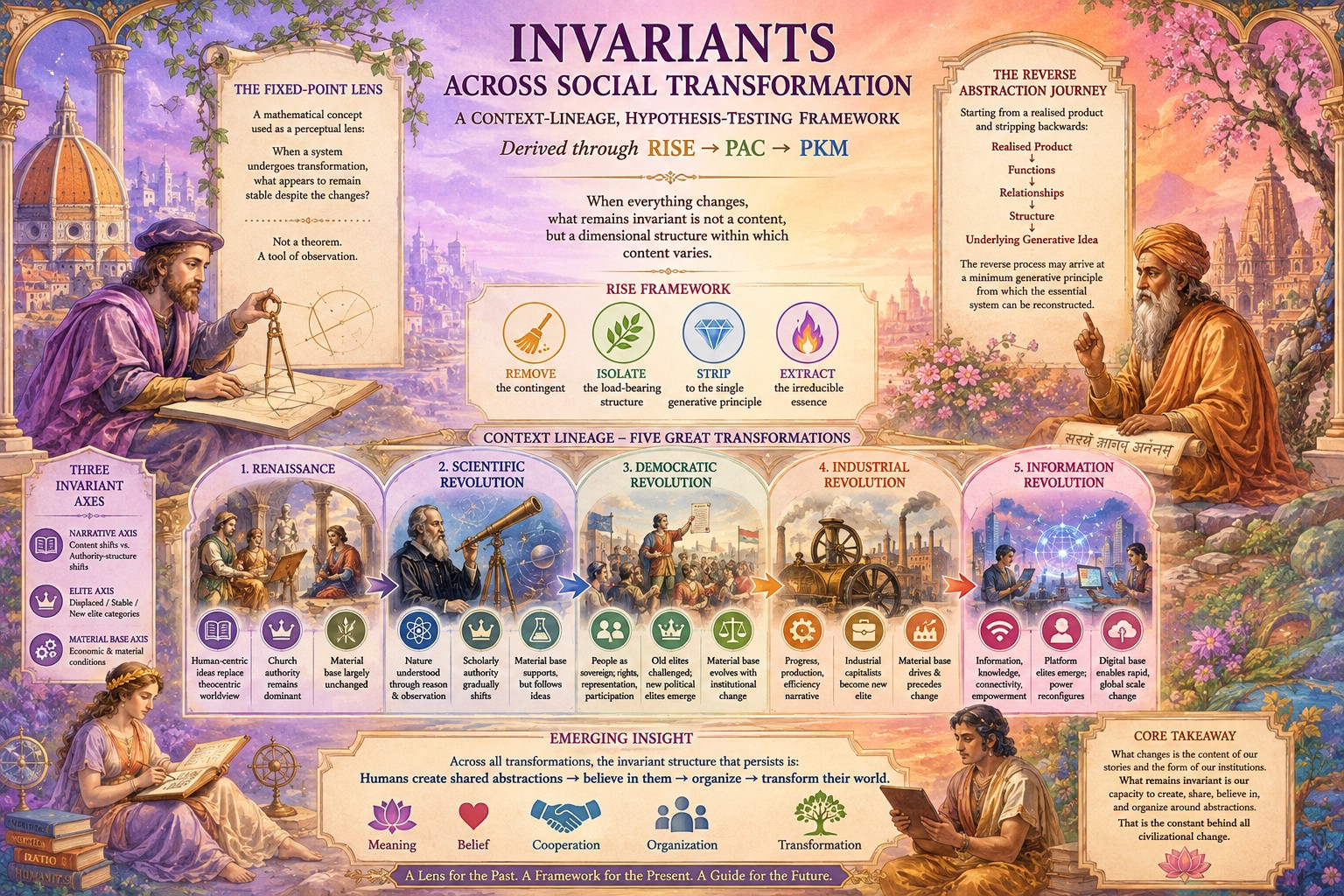
SRIJAN SANCHAR PERSPECTIVE ON SOCIAL TRANSPFORMATION
Derived through RISE → PAC → PKM
Preamble: Methodological Stance
This document
records a sustained first-principles inquiry into what remains invariant across
major social transformations in human history. It is produced as Srijan Sanchar
thought leadership, applying the RISE → PAC → PKM analytical pipeline to the
domain of civilisational change.
The inquiry
began with a perceptual lens — the mathematical concept of a fixed point, used
not as an imported theorem but as an instrument of observation: when a system
undergoes transformation, what appears to remain stable despite the changes?
This lens was applied sequentially across the Renaissance, the Scientific
Revolution, the Democratic Revolution, the Industrial Revolution, and the
Information Revolution, with each application testing, refining, and extending
the hypotheses generated by the previous.
The
objective is not to prove that history obeys a Fixed Point Theorem, but to ask
whether the fixed-point lens reveals persistent structures in history that
might otherwise remain hidden.
The
methodology is explicit: take a concept from one domain as a perceptual lens →
apply it without assuming equivalence → observe what it makes visible → compare
with established understanding → retain genuinely useful or novel insights. The
standard is the RISE operation — Remove the contingent, Isolate the
load-bearing structure, Strip to the single generative principle, Extract the
irreducible essence.
Section 1: The Fixed-Point Lens and the Reverse Abstraction
1.1 From Mathematics to
Perceptual Instrument
A
mathematical fixed point is a point x such that T(x) = x under a specified
transformation T. The inquiry deliberately does not import the theorem.
Instead, the concept is used as a perceptual lens: when everything changes,
what remains unchanged?
This lens was
first applied to geography (a spatial transformation with an invariant point),
then to product realisation. Starting from a realised product — an electric
two-wheeler — and stripping backwards through brand, materials, components,
manufacturing methods, and particular designs, the reverse journey was
identified:
●
Realised product → functions → relationships →
structure → underlying generative idea
The
interesting possibility: the reverse process may arrive at a minimum generative
principle from which the essential product could be reconstructed. This was
called, provisionally, a reverse fixed point. Its relationship to PAC
(Projective Analytic Continuity) was noted: multiple perspectives on the same
system → invariant structure recovered across projections → reconstruction. The
reverse abstraction operates along the same logical structure, with time rather
than perspective as the projection variable.
1.2 Applied to Social
Transformation
The same lens
was applied to social transformation, political revolution, and finally to the
history of humanity. The question shifts from "what stayed the same?"
(which yields either nothing or trivialities) to:
What
are the axes such that before and after are different coordinates on the same
axes — axes that are themselves invariant across transformations?
This
reframing dissolves the apparent paradox of searching for invariants inside
transformation. The invariant is not a content; it is a dimensional structure
within which content varies.
Section 2: Context Lineage — Transformations as Hypothesis Tests
Each major
transformation was run through two axes derived from first principles, and each
run refined the axes rather than merely illustrating them. The sequence
constitutes a context lineage: each case inherits the refined framework from
the previous and advances it further.
2.1 Axis Definitions
Two primary
axes were derived by stripping contingent features from the transformations
examined:
●
Narrative Axis: distinguishes (a) content shifts — what
beliefs, ideas, and cosmologies change — from (b) authority-structure shifts —
what counts as settling a question, and who has the right to do so.
●
Elite Axis: tracks whether existing authority-holders
are displaced, remain stable, or whether the transformation generates entirely
new elite categories not previously existing as distinct roles.
A third axis
— the material/economic base — emerged as a necessary addition when the
Industrial Revolution produced a case where the causal arrow appeared to
invert: material conditions preceding and shaping the narrative rather than
following it.
2.2 The Transformation
Matrix
The following
matrix records the hypothesis-test results across five transformations. Each
cell represents a finding derived from the transformation, not an assumption
brought to it.
|
Transformation |
Narrative Content |
Authority Structure |
Elite Displaced |
Elite Generated |
Material Axis |
|
Renaissance (~1400–1600) |
Shifts
— classical revival replaces scholasticism |
Shifts
— secular textual authority displaces theological |
Partial
— clerical intellectual authority |
Humanist
scholars as new sub-elite |
Follows
narrative |
|
Scientific Revolution
(1543–1687) |
Shifts
— heliocentric cosmology, empirical method |
Fundamental
shift — method replaces textual citation as arbiter of truth |
Clerical
intellectual authority |
Natural
philosophers; proto-scientific community |
Follows
narrative |
|
Democratic Revolution
(1776–1848) |
Radical
shift — popular sovereignty, natural rights |
Extends
Scientific Revolution's validator into governance domain |
Aristocratic
governing class delegitimated |
Political
class; journalist/public intellectual as interpreter |
Follows
narrative |
|
Industrial Revolution
(1760–1840) |
Radical
shift — progress, political economy, socialism as counter-narrative |
Continuous
with Scientific Revolution; method operationalised as engineering |
Guilds;
clerical economic authority |
Industrial
bourgeoisie; technical experts |
Precedes
narrative — causal arrow inverted |
|
Information Revolution
(1950s–present) |
Almost
unbounded content shift |
Dissolves
visible interpreter class; substitutes invisible algorithmic one |
Traditional
gatekeepers — publishers, broadcasters, encyclopaedias |
Platform
owners; paradoxically everyone and no one simultaneously |
Precedes
and shapes narrative at speed |
Key finding
from the matrix: the material axis being prior in the Industrial Revolution is
the one genuine anomaly — the only case where the causal arrow may run
differently. The framework reveals this as a real structural difference rather
than forcing all cases into the same shape.
2.3 The Fixed-Point
Comparison Across Transformations
|
Transformation |
What Changed |
What Persisted (Fixed Point) |
|
Renaissance |
Content
of authority — from theological to classical humanist |
Structural
need for an external textual validator and a scholarly interpreter class |
|
Scientific Revolution |
Nature
of authority — from text to method; who interprets legitimately |
Structural
requirement for an external, in-principle-verifiable reference point |
|
Democratic Revolution |
Domain
of authority — from natural phenomena to governance |
The
external validator inherited from Scientific Revolution; the
translation-layer requirement |
|
Industrial Revolution |
Scale
and mode of production; class structure |
The
Scientific Revolution's authority structure, operationalised; the
interpreter-class role |
|
Information Revolution |
Who
produces knowledge; how it circulates; speed of obsolescence |
Coordination-under-uncertainty
triangle; the gap between validator and population |
Section 3: The Emergent Invariant — Derived, Not Assumed
3.1 What Survives
Stripping Across All Cases
Across
Renaissance, Scientific Revolution, Democratic Revolution, Industrial
Revolution, and Information Revolution, the following structure appears in
every case without exception:
●
Something that resolves uncertainty — an external
validator — that claims authority beyond the individual and beyond the
immediate social group
●
Something that translates the resolution into
actionable shared understanding — an interpreter class — whose social authority
derives from proximity to the external validator
●
A collective — the population — that accepts or
contests the mediation
This triangle
is load-bearing: remove any vertex and the other two lose function. But the
vertices are not equally generative. The external validator is the prime mover
— every transformation begins with a claim about what settles questions, and
the other two reorganise around it.
3.2 The Interpreter-Class
Cycle
A generative
mechanism was derived — not imported from any existing theorist — from the
structural observation that the interpreter class consistently becomes the
establishment, which generates the conditions for the next challenge:
External
validator → interpreter class → interpreter class becomes establishment → new
transformation challenges interpreter class by proposing a new external
validator → repeat.
This cycle
has identifiable phases and is derivable from the triangle structure alone. It
converges with Kuhn's paradigm structure for intellectual transformations
specifically, and with Toynbee's challenge-response model at a broader
civilisational level — but was arrived at independently, which is the relevant
test.
3.3 The
External-Validator Sequence
Across the
transformations examined, the external validator takes successively different
instantiations while the structural requirement for one remains constant:
●
Scholastic period: scripture and classical texts —
external, accessible through education
●
Renaissance: classical antiquity recovered — external,
accessible through scholarship
●
Scientific Revolution: nature itself — external,
accessible through method
●
Democratic Revolution: natural law and the will of the
people — external, accessible through reason and public deliberation
●
Industrial Revolution: productive forces and economic
laws — external, accessible through technical expertise
●
Information Revolution: data, algorithms, network
effects — external, accessible to specialists; contested by everyone
Every
transformation changes what the external validator is. None eliminates the
structural need for one. The persistence of the structural need is the fixed
point; the specific instantiation is the coordinate that changes.
3.4 The Neutral Capacity
— Cooperation and Conflict from the Same Root
The inquiry
independently arrived at an insight that parallels Harari's central paradox but
states it more precisely:
The
human capacity to create shared abstractions is neither inherently beneficial
nor harmful. The same capacity can support civilisation, compassion, science,
law, and cooperation — or exclusion, fanaticism, and conflict. The boundary
condition that determines which direction the capacity runs is whether the
shared abstraction is held as universal or exclusive.
This is not a
moral observation but a structural one. The transition from universal ideal to
exclusive collective identity is the mechanism by which cooperation capacity
becomes conflict capacity:
●
Universal ideal → shared belief → collective identity →
large-scale cooperation
●
Collective identity → boundary → us and them →
exclusion → conflict
The same
capability, the same structural sequence, different boundary condition. This is
the deepest insight of the inquiry prior to the RISE distillation.
Section 4: RISE Distillation — The Irreducible Essence
The RISE
operation was applied to the entire sequence of findings as a stripping
procedure, not a summary. Each stage removed what was contingent,
context-specific, or reconstructible from something more basic.
4.1 Remove — What Was
Stripped
The following
were removed as contingent and reconstructible from more basic structure:
specific dates, geographies, named individuals, specific content of each
transformation, the specific historical sequence, and specific technologies.
What survived removal: three relationships present in every case (external
validator, interpreter class, population) and one dynamic (the interpreter
class becoming the establishment).
4.2 Isolate — The
Load-Bearing Structure
Testing which
relationship, if removed, collapses the others: all three are load-bearing, but
the external validator is the generative apex. The triangle — external
validator, interpreter class, population — is the load-bearing structure, with
the external validator as the prime mover.
4.3 Strip — The Single
Generative Principle
The triangle
is itself an instantiation of a more basic structure that appears across
scientific communities, legal systems, religious systems, and markets:
Any
system requiring collective coordination around uncertainty needs: something
that resolves the uncertainty (external validator); something that translates
the resolution into actionable shared understanding (interpreter class); and
the collective being coordinated (population). Transformation occurs when
either the resolution mechanism loses credibility or the translation layer
loses legitimacy as mediator.
This is not a
historical finding — it is a coordination-under-uncertainty structure. History
is one long instantiation of it.
4.4 Extract — The
Irreducible Essence
Final test:
can the external validator and the interpreter class be collapsed into one? In
all cases before AI: no. The external validator and the interpreter class are
always structurally distinct. The essence is therefore:
|
E1 |
Collective
coordination under uncertainty requires a legitimated resolution mechanism
(external validator) and a translation layer (interpreter class) between that
mechanism and the collective. This triangle is the load-bearing structure of
all social organisation. |
|
E2 |
Social
transformation occurs when either the external validator loses credibility or
the interpreter class loses legitimacy as mediator. Transformation is
complete when a new triangle stabilises — not when the old one collapses. |
|
E3 |
The
interpreter class always eventually becomes the establishment, generating the
conditions for the next transformation to challenge it. This is not
accidental — it is structurally inevitable given the triangle's internal
dynamics. |
|
E4 |
The
same human capacity that enables large-scale cooperation (shared abstraction
generation) also enables large-scale conflict. The capacity is structurally
neutral; the boundary condition — whether the abstraction is held as
universal or exclusive — determines which direction it runs. |
The
gap between the resolution mechanism and the collective is structurally
necessary — and that gap is what the interpreter class occupies. All social
authority derives from occupying that gap. Every social transformation is a
reorganisation of what fills the gap and who controls the filling.
Section 5: The AI Inflection — Inside an Unresolved Revolution
The
Information Revolution (1950s–present) is the first transformation in the
sequence to dissolve the distinction between the external validator and the
interpreter class — not by proposing a new validator, but by making everyone
simultaneously a producer and consumer of knowledge, while substituting an
invisible algorithmic interpreter class (platform engineers, recommendation
systems) for the visible one (editors, broadcasters, scholars).
The visible
interpreter class was dissolved; an invisible one was substituted. That
substitution is the central unresolved tension of the Information Revolution —
which remains incomplete, making it a transformation still in progress rather
than a resolved historical episode.
5.1 What AI Does
Structurally
Every
previous transformation replaced one interpreter class with another, while
keeping the external-validator → interpreter → population structure intact. AI
arrives into the unresolved Information Revolution and does something no
previous transformation has done:
AI
potentially eliminates the structural necessity of the interpreter class
entirely — not by making everyone an interpreter (the Information Revolution's
partial and unstable move) but by making interpretation itself automatable.
If
interpretation is automatable, the authority that derived from
interpreter-class proximity to the external validator dissolves. What replaces
it is not yet visible. This is a phase transition out of the cycle — not a new
iteration of the interpreter-class replacement pattern, but a structural break
in the cycle itself.
5.2 What the Framework
Predicts
Based on the
generative mechanism derived across all cases, the framework generates three
structural predictions for the AI transition:
●
A new external validator will be proposed —
AI-accessed-nature as an upgraded instantiation of the Scientific Revolution's
validator is the more stable resolution; AI-as-self-validator is circular and
structurally unstable.
●
A new interpreter class will attempt to form — those
who audit, align, evaluate, and govern AI systems. This is already visible as a
nascent formation (alignment researchers, AI policy specialists, evaluation
teams), following the pattern of natural philosophers forming around
experimental method.
●
The unresolved tension from the Information Revolution
will determine which way the transition breaks — toward a new stable triangle
with better accountability, or toward genuine dissolution of the triangle
structure.
5.3 The Genuinely Novel
Territory
Every
previous phase transition preserved the human as the irreducible unit — the one
doing the knowing, governing, producing, interpreting. Even when the
interpreter class changed, humans were doing the interpreting. The AI
inflection is the first transformation in the sequence that potentially removes
humans from a structurally necessary role — not changing which humans occupy
which role, but whether the role requires human occupancy at all.
This is
happening inside an already-unresolved revolution, which means there is no
stable prior authority structure to fall back on while the transition works
itself out. The inflection point is therefore arriving under the least
favourable structural conditions of any transition in the sequence.
Section 6: Comparison with Established Scholarship
The RISE
essence (E1–E4) was compared against the five most prominent scholars of
civilisational transformation: Harari, Diamond, Fukuyama, Huntington, and
Graeber & Wengrow. The comparison was conducted as a test of convergence
and contradiction, not as a literature review. The standard: does the RISE
framework independently arrive at — or contradict — the same structural
conclusions?
|
RISE Essence |
Harari |
Diamond |
Fukuyama |
Huntington |
Graeber & Wengrow |
|
E1 Coordination Triangle |
Strong
convergence — shared fictions map to external validator; triangle
architecture is new |
Partial
— geography as validator but no interpreter class or legitimation dynamic |
Partial
— rational recognition ≈ validator; liberal institutions ≈ interpreter class |
Weak
— civilizational identity is a boundary condition, not a coordination
mechanism |
Indirect
— political self-consciousness implies chosen validators; triangle not
formalised |
|
E2 Transformation Mechanism |
Convergence
— myth collapse maps to credibility loss, though framed as replacement not
structural failure |
Non-overlapping
— transformations driven by material conditions, not credibility dynamics |
Direct
contradiction — RISE predicts no permanent stability; Fukuyama requires it |
Partial
convergence — post-Cold War shift maps to interpreter class losing legitimacy |
Convergence
— repeated dismantling of hierarchy consistent with E2 |
|
E3 Interpreter-Class Cycle |
Present
but underdeveloped — ruling classes use fictions for power; cycle not derived
structurally |
Absent
— not Diamond's concern |
Direct
contradiction — E3 predicts liberal institutions generate their own
displacement |
Indirect
support — Cold War interpreter class losing credibility → civilisational
reassertion |
Strong
convergence — entire argument is that hierarchies repeatedly generate their
own displacement |
|
E4 Neutral Capacity |
Strong
convergence — shared fictions enable both civilisation and genocide; RISE
names the boundary condition |
Absent
as structural claim |
Direct
contradiction — Fukuyama resolves the duality; RISE holds it permanent |
Strong
convergence — civilisational identity is exactly the boundary condition that
turns capacity into conflict |
Convergence
— political experimentation implies boundary condition always chosen, not
determined |
6.1 Summary of Comparison
Findings
Finding 1 — Strongest
convergence: Harari, with added structural architecture
Harari names
the phenomena — shared fictions, cooperation, conflict potential. RISE derives
the mechanism — why the triangle forms, why it destabilises, why the cycle
repeats. Harari is the richest descriptive convergence; RISE is more
structurally generative. Neither is reducible to the other.
Finding 2 — Direct
contradiction: Fukuyama on E2 and E3
Fukuyama's
end of history requires a permanently stable validator and a permanently
legitimate interpreter class. E2 and E3 structurally predict that no such
stability is achievable. The post-2008 period — financial crisis delegitimating
the economic interpreter class, political ruptures of 2016, AI disruption of
epistemic authority — is consistent with RISE, not Fukuyama. This is the most
important disagreement in the comparison.
Finding 3 — Unexpected
convergence: Huntington on E4
Huntington
and RISE arrive at the same structural observation from different directions.
Huntington identifies civilisational identity as the post-Cold War conflict
driver; RISE identifies the boundary condition (universal vs. exclusive
abstraction) as the mechanism. Huntington's empirical observation is derivable
from RISE's structural claim, which gives RISE mild explanatory priority.
Finding 4 — Strong
convergence: Graeber and Wengrow on E3
Their entire
argument — that hierarchies repeatedly arose and were dismantled across human
prehistory — is precisely the interpreter-class cycle stated in archaeological
and anthropological terms. RISE derived the cycle from structural logic;
Graeber and Wengrow document it empirically across millennia. The convergence
is the strongest cross-methodology confirmation in the comparison.
Section 7: The Open Question
The
framework, having derived E1–E4 and located the AI inflection within the
unresolved Information Revolution, generates one question that it cannot answer
from first principles alone — because the answer requires looking forward
rather than backward, and the stripping operation can only run on completed
transformations:
If
authority has always derived from occupying the gap between the external
validator and the collective — and AI closes that gap — what new gap opens?
The stripping
operation across all of history suggests: wherever there is collective
coordination under uncertainty, a gap will form. Human ingenuity, entropy,
complexity, and the irreducible diversity of human values will always produce
new uncertainty faster than any resolution mechanism can resolve it. AI may
close the current gap. The question is what form the next gap takes and what
will occupy it.
This is the
point at which the framework hands back to human judgment, human values, and
human choice — not because the framework is exhausted, but because no
analytical framework derived from past transformations can determine the
outcome of a transformation that has not yet resolved. The determination
belongs to the people living inside it.
Meerut, Uttar Pradesh, India |
August 2026