
Blog Details
- Member
- February 28, 2026
SHARED REASSEBLY AND DECENTRALIZED MANUFACTURING
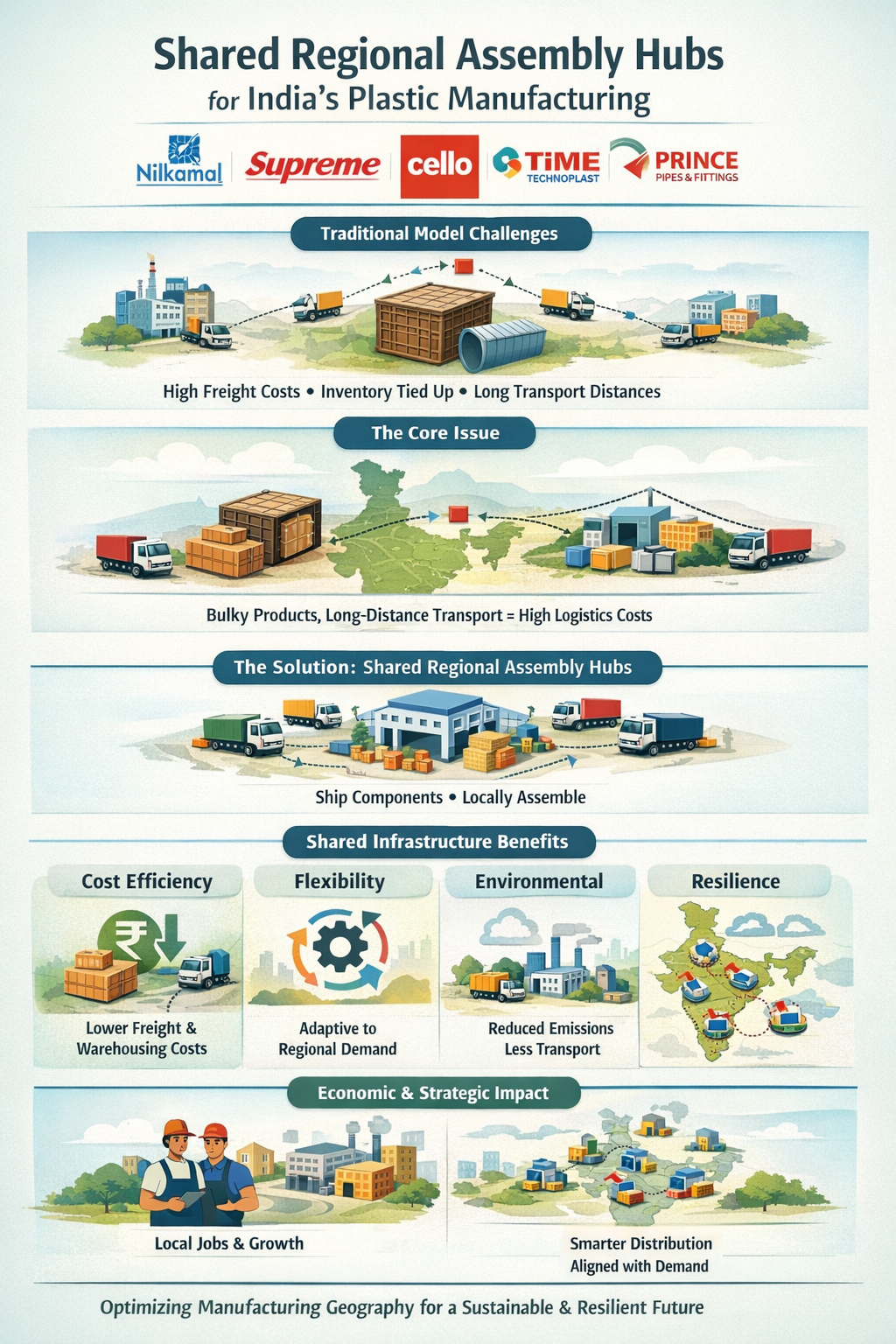
India’s plastic manufacturing sector, led by companies such as Nilkamal Limited, Supreme Industries, Cello World, Time Technoplast and Prince Pipes and Fittings, , produce high-volume goods that are lightweight but bulky. Storage crates, shelves, industrial containers, pipes, pallets and molded household products occupy significant transport space relative to their value. Under the traditional centralized manufacturing model, finished goods are produced in a few large plants and transported across long distances to serve national markets. This approach increasingly creates structural inefficiencies: high freight cost per unit, elevated working capital tied in inventory, longer replenishment cycles, and greater exposure to logistics disruptions.
The core issue is not production capability but transport intensity. When a product contains more air volume than material density, shipping fully assembled goods over hundreds or thousands of kilometers becomes economically suboptimal. Freight for such goods can represent a substantial share of the landed cost. As fuel prices fluctuate and sustainability expectations tighten, logistics-heavy models erode margins and reduce pricing flexibility. At the same time, demand in India is becoming more geographically distributed, with Tier-2 and Tier-3 cities contributing increasing consumption. This shift makes a purely centralized distribution architecture less aligned with emerging market realities.
A shared regional assembly hub model offers a structural response. Instead of transporting finished volumetric products nationwide, companies would ship semi-finished modules, stackable components, or flat subassemblies to strategically located regional hubs. These hubs would perform final assembly, customization, packaging, quality checks, and dispatch to dealers or e-commerce channels. Crucially, the hubs would not be captive to a single manufacturer. They would function as shared infrastructure serving multiple plastic molding companies simultaneously, thereby increasing utilization and reducing capital burden for each participant.
The relevance of this shared model lies in its ability to aggregate demand across brands. Different companies experience seasonal peaks and regional demand variations at different times. A multi-brand hub smooths throughput, improves labor productivity, and enhances equipment utilization. By sharing capital expenditure and operating infrastructure, the model lowers entry barriers to decentralization. Instead of each firm investing independently in micro-plants, they collectively access a regional finishing layer, transforming decentralization from a company-specific experiment into an ecosystem-level capability.
The benefits are multi-dimensional. Economically, regional assembly reduces long-haul freight of bulky finished goods, lowers warehousing requirements, minimizes product damage during transport, and shortens delivery cycles. Strategically, it enhances responsiveness to local demand, reduces stock-outs, and improves service to distributors and online platforms. Environmentally, it lowers fuel consumption and emissions associated with long-distance trucking, while opening opportunities for localized recycling integration. From a resilience perspective, distributed assembly capacity reduces dependence on a single production node and improves continuity during disruptions.
There is also a broader developmental need for such a model in India. As infrastructure expands and regional markets grow, distributed industrial activity becomes both economically rational and socially desirable. Shared assembly hubs can generate local employment, promote skill development, and strengthen regional dealer ecosystems. They align with national priorities around supply chain resilience, MSME participation, and sustainable industrial growth. Rather than replicating entire manufacturing plants in every region, this approach intelligently separates high-capital core production from lower-capital, demand-proximate assembly and finishing functions.
Ultimately, shared regional assembly hubs represent an infrastructure innovation rather than merely a cost-saving tactic. They address a structural inefficiency in how volumetric goods are moved across the country. For companies like and its peers, this model can improve margins while simultaneously reducing environmental impact and enhancing market responsiveness. At a system level, it redefines industrial geography — shifting from centralized manufacturing with dispersed consumption to a coordinated network where production and demand are more closely aligned.
The need is not only economic but strategic. As logistics costs rise, sustainability pressures intensify, and competition increases, companies that optimize their physical distribution architecture will gain durable advantage. Shared decentralized assembly is a pragmatic pathway to achieve that optimization while creating distributed value across regions.