
Blog Details
- Member
- March 10, 2026
Retro Innovation
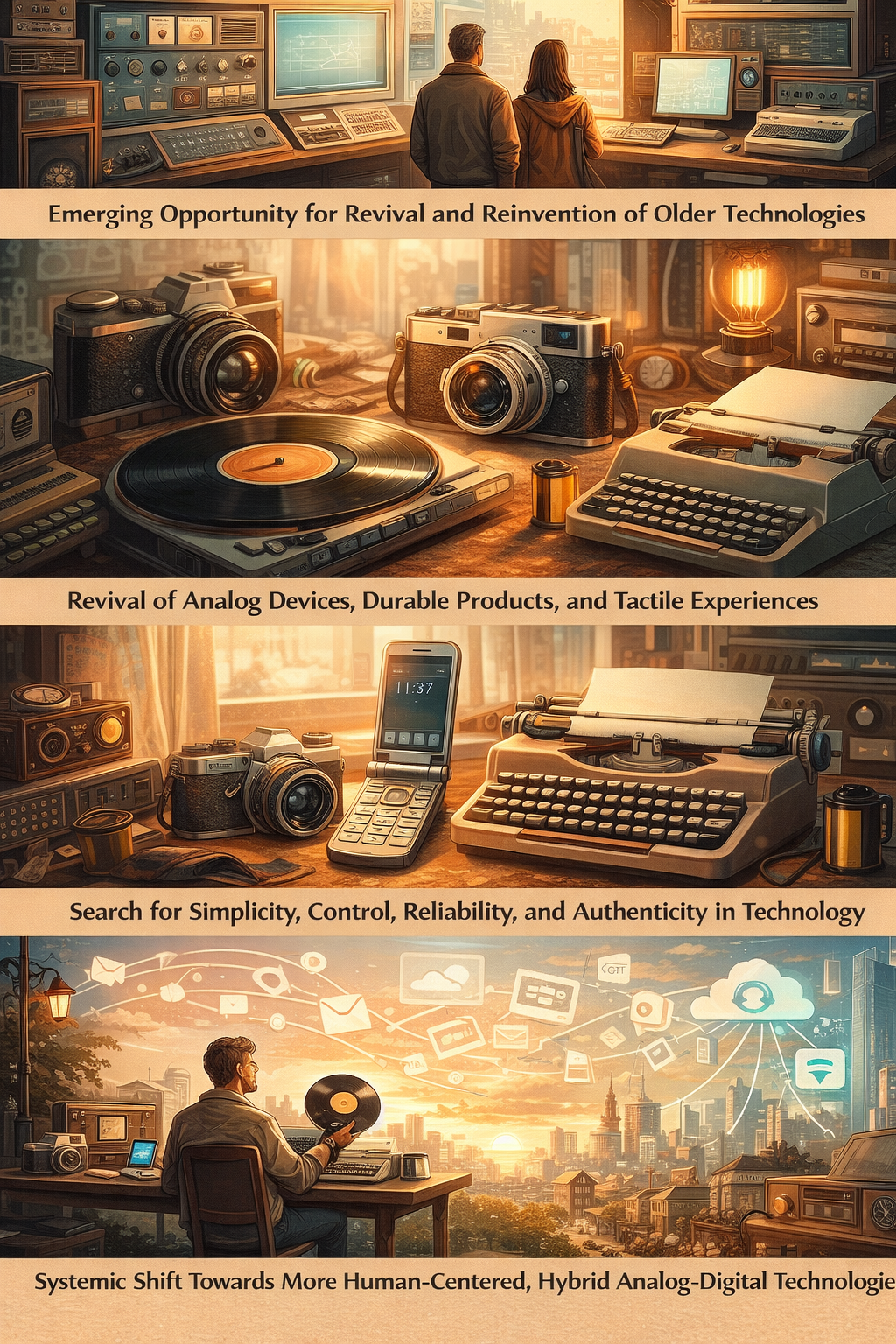
In an era defined by accelerating technological complexity, institutional fragility, and social fatigue with hyper-digital environments, a new opportunity has emerged around the revival and reinvention of older technologies. What appears on the surface as nostalgia is in fact a deeper systemic response to the pressures created by modern technological ecosystems. The renewed interest in analog devices, durable products, and tactile experiences reflects structural shifts in how individuals and markets evaluate technology. Rather than continuously demanding greater digital sophistication, many users are seeking systems that restore simplicity, control, reliability, and authenticity.
Several observable developments illustrate this emerging shift. Products once considered obsolete are returning to prominence. Vinyl records have reappeared as a preferred medium for music enthusiasts. Analog cameras are experiencing renewed interest among younger users who value the deliberate nature of film photography. Simple mobile phones with limited functionality are gaining traction among individuals seeking relief from constant connectivity and digital distraction. Board games and physical social experiences have grown in popularity as people look for meaningful interactions beyond screens. Even automobiles have begun reintroducing physical buttons and tactile controls after a period in which touch-screens dominated design philosophy. These phenomena collectively indicate a growing desire for human-scale technologies.
These observable patterns are linked to several underlying structural forces. One is the dominance of complex digital ecosystems built around artificial intelligence, constant connectivity, and algorithmic control. Another is the widespread adoption of business models that depend on planned obsolescence, frequent upgrades, and subscription-based ownership rather than durable products. Global supply chains have also demonstrated fragility, particularly during disruptions that reveal the vulnerability of highly optimized systems. At the same time, sustainability concerns are encouraging longer product lifecycles, repairability, and material efficiency. These structural conditions have produced an environment in which consumers and organizations are beginning to question whether perpetual technological complexity actually serves human needs.
As these structural pressures manifest in everyday experience, a set of new narratives has begun to emerge. Ideas such as “slow technology,” digital minimalism, and human-centered design have entered public discourse. Increasingly, people are questioning the assumption that technological progress must always mean greater automation and complexity. Instead, attention is shifting toward authenticity, craftsmanship, resilience, and the psychological value of physical interaction with tools and devices. The revival of analog technologies therefore represents not a rejection of innovation, but a search for a more balanced relationship between humans and technology.
If current trends continue, several possible future trajectories may unfold. One possibility is the emergence of what could be described as an “analog renaissance.” In such a future, distrust in algorithmic systems and concerns about resilience may lead governments and industries to actively support durable, repairable technologies. Environmental policies promoting circular economies would reinforce the value of long-lasting products. Local manufacturing could expand as supply chains shorten and communities prioritize resilience. Mechanical devices, repairable electronics, and physical media could regain a significant share of markets. In this environment, craftsmanship and durability would become key sources of economic value.
Another plausible direction involves a hybrid technological landscape in which analog experiences coexist with digital infrastructure. In this scenario, digital systems remain dominant, but companies deliberately incorporate analog elements to create richer user experiences. Vinyl records might integrate seamlessly with digital streaming platforms. Writing devices could combine the tactile feel of typewriters with cloud synchronization. Smartphones might include modes designed to restrict digital distractions while preserving essential connectivity. Rather than replacing digital technology, analog elements would provide balance and emotional depth. Such hybrid systems could become an important strategy for product differentiation and brand identity.
A third possibility is that retro technologies evolve into luxury identity signals. As artificial intelligence and automated systems increasingly shape everyday life, handcrafted and mechanical objects may acquire symbolic value as markers of authenticity and individuality. Mechanical watches, film cameras, handcrafted instruments, and other artisanal products could become premium goods representing human skill and cultural heritage. In such a world, the appeal of retro technologies would lie less in their practical function and more in their ability to signal taste, tradition, and personal identity.
Across these possible futures, certain qualities appear consistently valuable. Durability, physical ownership, and tactile interaction remain deeply appreciated characteristics of technology. At the same time, other features—such as connectivity, digital augmentation, and distribution models—are likely to continue evolving. Certain aspects of modern technological systems, particularly those related to planned obsolescence and forced subscription models, may increasingly face resistance. Meanwhile, capabilities that have been neglected or marginalized, including mechanical craftsmanship, modular design, and offline functionality, may regain importance as dormant capabilities ready to be reactivated.
For organizations seeking to benefit from this emerging landscape, several strategic directions become apparent. One is the systematic exploration of historical product archives and dormant patents. Many companies possess legacy designs that were discontinued not because they lacked value, but because market conditions at the time favored other technological trajectories. Reexamining these archives may reveal opportunities to revive proven concepts with modern enhancements. Another strategy involves combining analog interfaces with digital infrastructure, creating products that retain tactile and human-centered qualities while leveraging the power of modern networks and data systems. A third approach involves deliberate simplification—removing unnecessary complexity from products in order to focus on clarity of function and quality of experience.
Taken together, these developments suggest that retro-innovation represents a deeper evolutionary phase in technological development. Industrial technologies initially emphasized mechanical simplicity and durability. This phase was followed by a period of rapid digital expansion characterized by increasing complexity and automation. The next stage may involve a synthesis in which the strengths of both traditions are combined. Technologies of the future may therefore integrate the reliability and human-scale design of analog systems with the connectivity and intelligence of digital infrastructure.
In this broader perspective, the resurgence of retro technologies should not be viewed merely as nostalgia or aesthetic preference. Instead, it reflects an ongoing search for equilibrium between technological capability and human well-being. As digital systems continue to expand in scale and influence, societies and markets are rediscovering the enduring value of simplicity, craftsmanship, and tangible interaction. Retro-innovation thus becomes a bridge between the industrial past and the emerging future of human-centered technological ecosystems.