
Blog Details
- Member
- March 1, 2026
Low Altitude Bio CNG Airship System for Rural Energy Transport
Srijan Sanchar Proposal
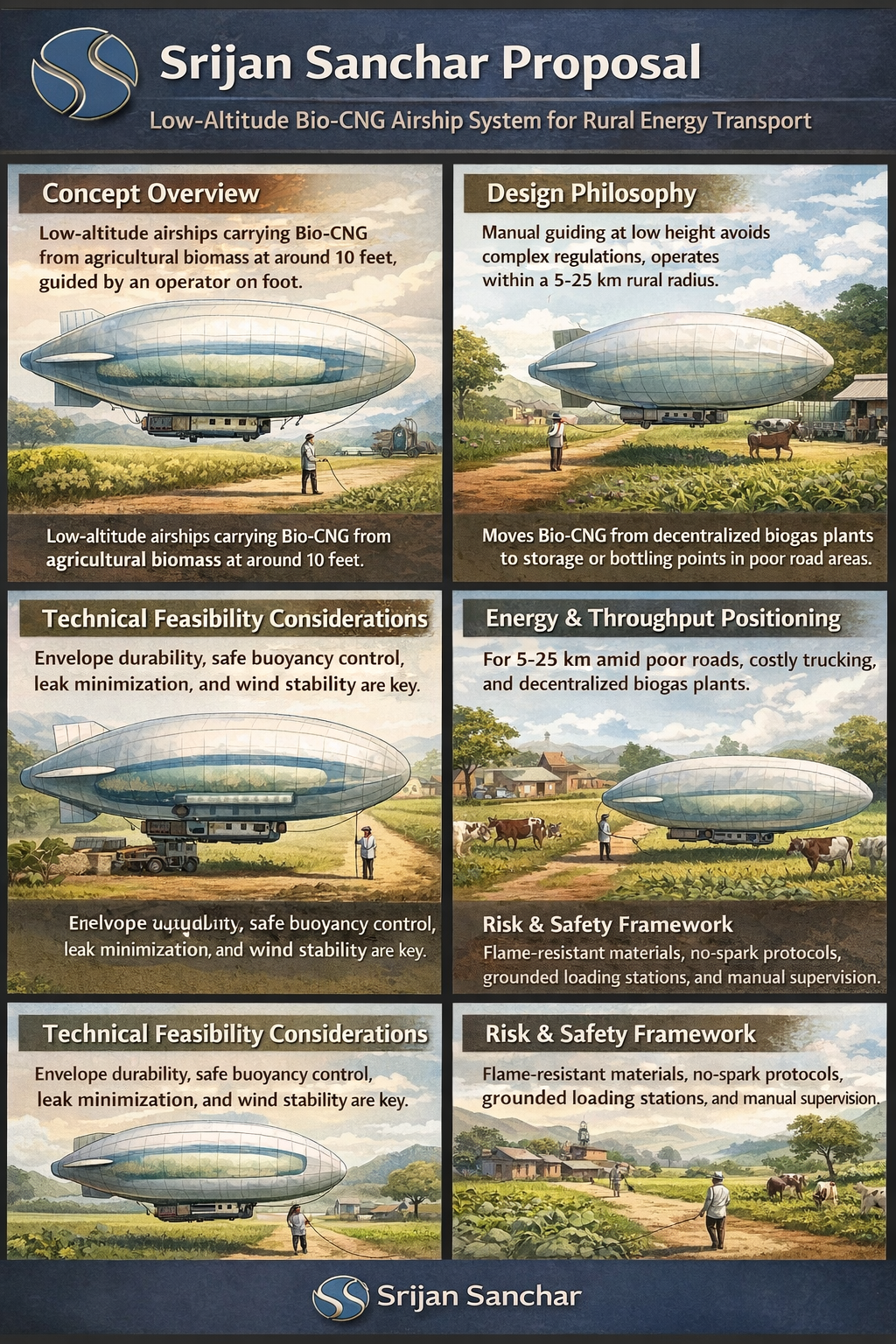
Low-Altitude Bio-CNG Airship System for Rural Energy Transport
Concept Overview
Srijan Sanchar proposes a localized, low-altitude airship transport system designed specifically for rural distribution of Bio-CNG generated from agricultural biomass. Unlike large, high-altitude cargo airships, this model operates at approximately 10 feet above ground level and is manually guided by a trained operator walking below. The objective is not long-distance bulk transport, but short-range village-to-village movement of Bio-CNG from decentralized biogas plants to local aggregation points, bottling stations, or community fueling hubs.
The system uses lightweight, non-pressurized gas containment bags suspended within a helium-assisted envelope. Because methane—the primary component of Bio-CNG—is lighter than air, it provides partial buoyant lift. This reduces the structural load requirements of the envelope and minimizes the need for heavy high-pressure steel cylinders typically used in conventional transport. The airship effectively “floats” the gas across short rural distances with minimal ground friction and minimal fuel consumption.
---
Design Philosophy
The Srijan Sanchar rural airship is intentionally small and modular. Instead of a 35,000 m³ structure, the rural version may operate in the 500–3,000 m³ range, optimized for local payload needs. The envelope provides partial helium lift while the Bio-CNG itself contributes additional buoyancy. The system is tether-guided by a ground operator who ensures path control, obstacle avoidance, and safety.
Operating at approximately 10 feet above ground offers several advantages:
Eliminates complex aviation regulatory requirements.
Avoids high-altitude wind exposure.
Enables visual supervision at all times.
Reduces propulsion complexity (movement may rely on gentle electric thrusters or manual towing support).
The airship functions more like a floating pipeline segment than a conventional aircraft.
---
Operational Model in Rural Context
Bio-CNG plants in rural areas often face a logistics bottleneck: transporting gas cylinders to nearby towns or CNG bottling points requires trucks, diesel fuel, road access, and heavy handling equipment. In many villages, poor road conditions increase transport cost and emissions.
The proposed airship would:
1. Load Bio-CNG into flexible containment bags at the biogas plant.
2. Lift gently with helium-assisted buoyancy.
3. Be guided by a trained local operator walking along designated rural pathways.
4. Deliver gas to a central village storage or bottling point.
5. Return with minor ballast adjustment.
Because the system operates at low height and low speed, it is designed for safety, simplicity, and rural employment generation.
---
Technical Feasibility Considerations
The physical principle remains valid: methane is lighter than air. However, practical viability depends on:
Envelope material durability.
Leak-proof containment design.
Controlled buoyancy balance.
Safe static electricity management.
Wind stability at low altitude.
Unlike large-scale airships, this rural system reduces structural mass and propulsion complexity. Nevertheless, containment integrity is critical. Bio-CNG leakage must be minimized not only for safety but also for climate responsibility, as methane has high global warming potential.
Helium use must be optimized. Hybrid buoyancy systems may reduce helium requirement by combining partial lift with lightweight structural framing.
---
Energy and Throughput Positioning
This proposal does not aim to compete with pipelines or LNG shipping. It is intended for short-range distribution within a 5–25 km rural radius. Energy density constraints are less critical in this context because transport volumes are modest and localized.
The system is best positioned where:
Road access is poor.
Truck transport is expensive.
Cylinder logistics are inefficient.
Small decentralized biogas plants require aggregation.
In such settings, even modest transport capacity can significantly reduce handling costs and diesel consumption.
---
Risk and Safety Framework
Operating at low altitude significantly reduces catastrophic aviation risk. However, methane flammability remains a central concern. Safety measures include:
Flame-resistant envelope materials.
Strict no-spark handling protocols.
Grounded loading stations.
Weather restrictions during high wind.
Continuous manual supervision.
Because the airship operates near ground level, emergency venting procedures can be safely executed in open agricultural areas if required.
---
Rural Development Impact
This proposal aligns strongly with agricultural circular economy models. Bio-CNG generated from crop residue, dung, and biomass can be transported without heavy trucking infrastructure. The system can create local employment for operators, maintenance workers, and gas handling technicians.
Potential benefits include:
Reduced diesel use in rural transport.
Monetization of agricultural waste.
Decentralized energy distribution.
Lower infrastructure capital compared to pipeline expansion.
Demonstration of innovative rural technology.
---
Scalability Path
Initial deployment can begin with pilot clusters in districts with active Bio-CNG plants. Over time, the system may evolve toward:
Electrically assisted propulsion.
Smart tether guidance systems.
Solar-assisted auxiliary systems.
Standardized modular envelopes.
Future adaptation could include hydrogen transport if rural green hydrogen production emerges.
---
Strategic Positioning
The Srijan Sanchar Low-Altitude Bio-CNG Airship System is not a replacement for pipelines or large-scale energy logistics. It is a localized, low-capital, low-speed, low-altitude rural transport innovation designed to bridge short-distance energy gaps in agricultural regions.
Its strength lies in simplicity, decentralization, and alignment with rural sustainability goals. Feasibility depends on careful engineering refinement, strict methane containment, and disciplined operational protocols. If successfully piloted, it could represent a new category of micro-aerial rural infrastructure—lightweight, visible, and community-operated.
In essence, this proposal reimagines energy transport not as heavy industrial movement, but as buoyancy-assisted rural mobility rooted in local biomass economics.